
Countdown to Annual Conference
San Antonio, Tex.
March 6-8, 2010
Home
MISSION: ASCD (formerly the Association for Supervision and Curriculum Development) is a membership organization that develops programs, products, and services essential to the way educators learn, teach, and lead.
We are here to help!
1703 North Beauregard St.
Alexandria, VA 22311-1714

Tel: 1-800-933-ASCD (2723)
Fax: 1-703-575-5400

8:00 a.m. to 6:00 p.m. EST Monday through Friday

Local to the D.C. area:
703-578-9600, press 1

Toll-free from the U.S. and Canada: 1-800-933-ASCD (2723), press 1

All other countries (International Access Code): +1-703-578-9600, press 1
Permissions and Translations
ASCD recognizes and respects intellectual property rights and adheres to copyright law. Learn about our rights and permissions policies.


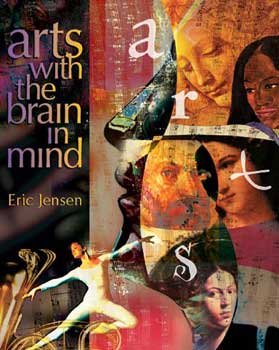
Arts with the Brain in Mind

by Eric Jensen

Table of Contents


Preface

I think it's fair for me to state up front what my biases are. You deserve to know what flavors this book. First, I am not, in any traditional way, an artist. We all create our lives in a broadly artistic way, and writing is certainly some kind of art or skill. But I have no vested interest in pushing any particular art expression. Second, I have no children enrolled in any schools where I'm trying to influence someone's education, in particular. And third, I am deeply committed to making a significant, positive, and lasting contribution to the education of all children. Although I do workshops and speak at conferences on learning with the brain in mind, I am, above all, an advocate for improving education. It has been through my research that I have come to support the arts.

This book is an exploration of how I came to support the arts. I started with three major questions. First, how do the arts stack up as a major discipline? Second, what is their effect on the brain, learning, and human development? Third, how might schools best implement and assess an arts program?

Education is not an either-or scenario. It's not the arts versus a rigorous, demanding curriculum. I want learning to be engaging, challenging, vigorous, and integrated. The arts should not be a path only for the alternative learner or those who would otherwise fail, any more than math is an easy path for those who can't do arts. I favor challenging work in all the disciplines (arts as one of them), with regular, accurate, and purposeful assessment and strong standards in learning.

Education must be attentive to individual differences and community building. Student-centered learning is better than teacher-centered learning. I support constructivism over mindless factual accumulation, and I favor depth over breadth of knowledge. I favor variety in education over one-size-fits-all. I want our schools to foster ethical, fair-minded, disciplined, cooperative, thoughtful, considerate, problem-solving, creative citizens.

Flying in the face of these hopes is an educational juggernaut unlike any we've seen in recent history. It's called “higher standards,” and it's the latest version of the politician's Holy Grail. Some believe that higher standards will ensure that all learners do better in school. That may or may not be true. But there is no evidence that higher standards actually produces better human beings—unless accompanied by better-quality teaching, more targeted resources, greater opportunities for underserved populations, stronger role models, high expectations, and a dozen other key variables.

To reach these standards, educators seek some kind of strategy to get over the hump—some kind of “magic pill.” Some are calling for a more rigorous core curriculum; for others, it's learning styles; and still others are determined that the multiple intelligences model will do the trick. The fact is, humans are unique; and educators need different approaches and strategies to reach a wide range of learners. Believe it or not, many schools, districts, and states have been using a powerful solution for decades. It's called the arts.

By making arts a core part of the basic curriculum and thoughtfully integrating the arts into every subject, you might not get the high test scores you want immediately. The evidence is mixed on that issue, though it leans in favor of the arts. If you do get higher scores, it certainly won't happen overnight. But much more important, you may get fewer dropouts, higher attendance, better team players, an increased love of learning, greater student dignity, enhanced creativity, a more prepared citizen for the workplace of tomorrow, and greater cultural awareness as a bonus. This book demonstrates that the collective data not only support the value of widespread arts implementation, but the evidence also shows no downside risk.

Only 28 of 50 states in the United States have arts requirements for graduation (Kantrowitz & Leslie, 1997). At least, that's up from just 2 states in 1980. A federally mandated basic arts education policy does not exist. That's not just embarrassing and inexcusable; it's irresponsible. Sufficient data exist to overwhelmingly support the fundamental value and role of arts on equal standing with every other so-called academic discipline, including science, languages, and math. It can no longer be called a “cultural add-on” or “right-brained frill.” The times are changing, and arts are roaring back into curriculums with renewed purpose. They can no longer be targeted as a desperate solution for inner-city schools.

Art advocates are constantly being asked to show evidence that, for example, music improves math scores. Let's turn that around: Does math improve music? No one asks the questions, “Does math improve the arts? Does science improve reading? Does English actually improve the mind, or does it only serve as an accumulation of a snobbish bravado?” The fact is, we have historically assumed that other disciplines (excluding art) are valuable; yet they are not held to the same level of scrutiny to which art is now being held. For the few who remain convinced, after reading this book, that the arts are a frill, you might as well let computers take over and run civilization from a motherboard in an underground silo. Without arts, we can pack our tents, admit we have lost our humanity, and all go home to an online, pay-per-grade, computer-based education.

As we begin the new millennium, one of the questions raised will be “What can't technology do?” Computers will amass, modify, and manipulate data like never before. Revolutionary software programs will calculate, sort, summarize, write, edit, translate, compose, and present knowledge in unimaginable new ways. But what makes us most human is what will be the most desirable commodity. That's the ability to thoughtfully regulate, express, and channel emotions into arts such as music, performances, movement, painting, and design. Art will increase, not decrease in value.

The thesis of this book is that arts are not only fundamental to success in our demanding, highly technical, fast-moving world, but they are what makes us most human, most complete as people. Arts contribute to our growth as human beings. The time has come to take the arts seriously. At a time when higher standards are being thrust on all of us, arts have an even bigger place. Even if one could get the higher scores without a basic or integrated arts curriculum, do you really want to live in a world where the best that we have to offer is a high-test-score graduate, but a person who can't work with others, be creative and express himself, solve real-world problems, and do it with civility? I would not choose that world; would you?

Obviously, I'm making some strong claims about the value of arts. I want you to know I did not come to that decision frivolously. In this book I cite the scientific basis for my claims, as well as provide real-world examples of how to implement and how to assess an arts program. Though there will still be skeptics who are uncomfortable with a stronger arts role in school, the facts are in: You can make as good a case, or better, for arts than you can make for any other discipline.


Table of Contents


Copyright © 2001 by Eric Jensen. All rights reserved. No part of this publication—including the drawings, graphs, illustrations, or chapters, except for brief quotations in critical reviews or articles—may be reproduced or transmitted in any form or by any means, electronic or mechanical, including photocopy, recording, or any information storage and retrieval system, without permission from ASCD.

MEMBER SIGN IN
Username or Customer ID
Password