

Countdown to Annual Conference
San Antonio, Tex.
March 6-8, 2010
Home
MISSION: ASCD (formerly the Association for Supervision and Curriculum Development) is a membership organization that develops programs, products, and services essential to the way educators learn, teach, and lead.
We are here to help!
1703 North Beauregard St.
Alexandria, VA 22311-1714

Tel: 1-800-933-ASCD (2723)
Fax: 1-703-575-5400

8:00 a.m. to 6:00 p.m. EST Monday through Friday

Local to the D.C. area:
703-578-9600, press 1

Toll-free from the U.S. and Canada: 1-800-933-ASCD (2723), press 1

All other countries (International Access Code): +1-703-578-9600, press 1
Permissions and Translations
ASCD recognizes and respects intellectual property rights and adheres to copyright law. Learn about our rights and permissions policies.


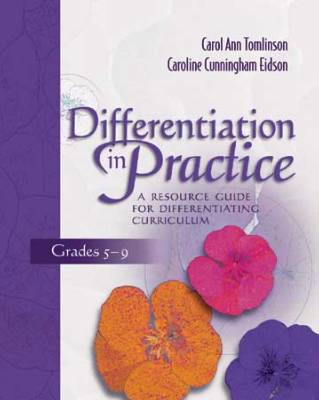
Differentiation in Practice

by Carol Ann Tomlinson and Caroline Cunningham Eidson

Table of Contents


Introduction

This book is part of a series of ASCD publications on differentiating instruction. Each is designed to play a particular role in helping educators think about and develop classrooms that attend to learner needs as they guide learners through a curricular sequence.

How to Differentiate Instruction in Mixed-Ability Classrooms (Tomlinson, 2001) explains the basic framework of differentiation. Such a framework allows teachers to plan in consistent and coherent ways. The Differentiated Classroom: Responding to the Needs of All Learners (Tomlinson, 1999a) elaborates on the framework and describes classroom scenarios in which differentiation is taking place. A third book, Leadership for Differentiating Schools and Classrooms(Tomlinson & Allan, 2000), discusses how to link what we know about school change with the goals of differentiation and seeks to provide guidance for educational leaders who want to be a part of promoting and supporting responsive instruction. In addition to these books, an ASCD Professional Inquiry Kit called Differentiating Instruction for Mixed-Ability Classrooms (Tomlinson, 1996) guides educators, in an inductive manner, to explore and apply key principles of differentiation.

Three video programs, all produced by Leslie Kiernan and ASCD, give progressively expansive images of how differentiation actually looks in the classroom. Differentiating Instruction (1997) shows brief applications of differentiating content, process, and products according to student readiness, interest, and learning profile in primary, elementary, middle, and high school classrooms. It also illustrates a number of instructional strategies used for purposes of differentiating or modifying instruction. At Work in the Differentiated Classroom(2001) shows excerpts from a month-long unit in a middle school classroom as means of exploring essential principles of differentiation, examines management in differentiated settings from primary grades through high school, and probes the role of the teacher in a differentiated classroom. A Visit to a Differentiated Classroom (2001) takes viewers through a single day in a multi-age, differentiated elementary classroom. Each of these materials attempts to help educators think about the nature of classrooms that are defensibly differentiated and move toward development of such classrooms. Each of the publications plays a different role in the process of reflection, definition, and translation.

This book uses yet another lens to examine differentiation and support its implementation in classrooms. It presents a series of actual curricular units developed by teachers who work hard to differentiate instruction in their classrooms. The book thus moves from defining and describing differentiation to providing the actual curriculum used to differentiate instruction.

Differentiation and the Middle Grades

It can be argued that the middle-grade years constitute the greatest learner variability of any segment in school. Dissimilar rates of growth are a defining element of middle school. Students of the same age vary tremendously in intellectual development, as they do in physical, emotional, and moral development. Schools that aspire to be successful in educating young adolescents must vigorously attend to their varying needs, interests, and readiness levels (National Middle School Association, 1995). Such schools will begin where learners are, understanding and addressing their individual needs, interests, and modes of learning.

Given the developmental diversity in any middle-level classroom, gearing curriculum to students' levels of understanding is a daunting task. In addition to different rates of development and learning styles, varying cultural backgrounds and prior experience must be taken into account. Efforts to reduce tracking and to include students with special needs in regular classes increase the diversity even further.... Both content and methods must be individualized. (National Middle School Association, 1995, pp. 21–22)

Ironically, the prospect of teaching with the inevitable diversity that typifies middle school is one of the factors that makes it easy for teachers to “slip into a teaching mode in which all students in a class are expected to be doing or learning the same things at the same time according to a single mode of instruction” (Stevenson, 1992, p. 20). Nonetheless, middle school experts caution that reliance upon such instruction is ill-suited to the population middle schools exist to serve.

In order for all students to experience successes that matter to them, schoolwork must accommodate individual differences of talent and development. Students are developmentally unequal. Therefore, educators must ensure that for a substantial portion of their school lives, students will be able to see their success along a variety of paths. Teachers' expectations must reflect an understanding of differences. Some portions of curriculum must accommodate individual choices. Ways of presenting knowledge must complement disparities in youngsters' talents or dispositions for revealing their knowledge. (Stevenson, 1992, p. 122)

Turning Points, 2000 (Jackson & Davis, 2000), a 10-year update on the original Turning Pointsdocument that defined the key principles and practices of effective middle level schools, presents seven recommendations essential to ensuring success for each middle schooler in a new century. The document's explanation of one of those principles notes, in part, that “classes should include students of diverse needs, achievement levels, interests, and learning styles, and instruction should be differentiated to take advantage of the diversity, not ignore it” (Jackson & Davis, 2000, p. 23). This same landmark report calls for concept-based teaching that helps adolescent learners structure what they learn in effective and memorable ways and for classrooms procedures and processes designed to help young adolescents become more self-sufficient and confident learners.

It is difficult to imagine a setting with greater potential to realize the joy that should be implicit in learning than a middle school classroom, with learners bringing to school a spectrum of dreams for the future and a full supply of energy. Each of these students has one foot in the world of childhood and one on the brink of adulthood, combining the fullness of creativity and the infinite possibilities ahead. It is difficult to imagine a setting more pained and unnatural than a middle school classroom with a one-size-fits-all demeanor and mode of operation housing those same students.

Nonetheless, it's far easier to find examples of the latter than the former. The reasons classrooms downplay or even ignore diversity are legion, and many of the reasons are understandable. One is the absence of images of what solid, standards-based curriculum might look like in settings that both embrace and attend to learner diversity. This book provides one such image—an image we hope will help educators craft middle-level classrooms well suited to the learning needs of the students who inhabit and enliven them.

What the Book Is (and Isn't) Intended to Be

As we prepared to write this book, we had numerous conversations between ourselves, with editors, and with many colleagues in education. Each conversation helped us chart our eventual course. Our primary goal was to provide models of differentiated units of study. We wanted to move beyond necessarily episodic descriptions of differentiation to show how a differentiated classroom might flow through an entire unit. We also wanted to present units at a range of grade levels and in a variety of subjects. Providing units for grades K–12 in a single volume seemed too much, so we began by working with units that span grades 5–9, a configuration otherwise known as “the middle grades.” In some districts, this grade-span includes at least a portion of upper elementary or a portion of high school. Subsequent books of differentiated units for grades K–5 and 9–12 are in the works.

Even after narrowing the range of grade-levels, we realized there were so many subjects to consider that we had to refine our focus further. Ultimately, we elected to include differentiated units in five subject areas: math, science, social studies (two units), language arts, and world/foreign language. We have developed the book, however, with the intent that it be useful to a broader range of teachers than the grade levels and subjects it specifically represents. This is a book designed to teach anyone who wants to learn about differentiating curriculum how to do so—or how to do so more effectively.

To that end, each of the units is intended to be more representative than restrictive. That is, an 11th grade social studies teacher should be able to look at a 6th grade social studies unit, see how it works, and use similar principles and formats to develop a differentiated social studies unit for high school juniors. An art teacher should be able to study several of the units in the book and synthesize the principles and procedures therein to guide the development of a differentiated art unit. In sum, we intend this book to be a vehicle for professional development.

What this book is not intended to be is off-the-shelf curriculum for any classroom. It is impossible to create the “correct” unit, for example, on how to teach French verbs. Teachers in one classroom will conceive that process differently than will teachers in other classrooms—or teachers in a different part of the country, in a different type of school, or responsible for a different set of academic standards. In the end, then, we are presenting educators with a learning tool, not a teaching tool. If teachers (and other educators) can read this book and say, “There's something I can learn here,” then we will have succeeded.

How the Book Is Designed

Because we want the book to be a learning tool for a maximum number of teachers, we have made key decisions about its presentation. First, we decided to begin the book with Part I's primer on differentiation—an essential piece for readers new to the topic and a helpful refresher for those already familiar with it. We also opted to include an extended glossary (page 233), which explains terms and strategies that might not be familiar to all readers. Collecting this information in the back of the book, we thought, was preferable to interrupting the units themselves with “sidebar” explanations.

Part II, the body of the book, is devoted to instructional units. We think it will be helpful to share some of our thinking about the layout and contents of the units, each of which is presented in four parts.

  • Unit Introduction. The first component of every unit is the introduction, which includes a prose overview of the unit; a list of standards addressed in the unit; the key concepts and generalizations that help with teacher and student focus; a delineation of what students should know, understand, and be able to do as a result of the unit; and a list of the key instructional strategies used in the unit. Some of the units also make links across units and disciplines and promote connections with students' lives and experiences.
  • Unit Overview Chart. The second component is an overview chart, designed with three goals in mind: 1) to provide orientation in the form of a “big picture” snapshot of the unit's steps or events; 2) to provide an estimate of the amount of time each step or event requires; and 3) to clarify which portions of the unit apply to the class as a whole and which are differentiated.
  • Unit Description. The third component is the unit description itself. It appears in the left-hand column of each unit page and gives a step-by-step explanation of what takes place in the classroom during the unit. Asterisks in the margins highlight differentiated components. All referenced supporting materials (samples such as worksheets, product assignments, rubrics, and homework handouts) appear at the end of the unit.
  • Teacher Commentary. The fourth component is an explanation, in the voice of the teacher who created the unit, of what she was thinking as she planned and presented instruction. For our purposes, this is a particularly valuable element. To listen to the teacher who developed the unit is to move well beyond what happens in the classroom and to begin to analyze why teachers make decisions as they do. At one point in the writing and editing process, we thought we should reduce the teacher commentary sections to the fewest possible words; we quickly discovered that when we did so, we lost the magic the book has to offer. We hope you enjoy listening to the teachers as much as we have.

We tried to balance two needs in our editing of the units. First, we wanted to maintain the integrity of each teacher's unit. Second, we wanted to be sure to have both consistency (of terminology, of format, of essential philosophy) and variety (in instructional strategies, use of groups, assessment methods, etc.). The teachers who created the units have approved the changes we made or have helped us see how to make necessary modifications more appropriately.

Also, please note that we have opted to make the units somewhat more generic than specific. As teachers, we sometimes have the habit of looking for exact matches for our classroom needs and jettisoning whatever doesn't match. As authors, we can't eliminate the habit, but we wanted to make it a little harder to exercise. For example, although we have taken great care to list state standards reflected in a unit, we have intentionally not listed the name of the state from which the standards came. (It's amazing how similar standards on the same topic are across states.) We're hopeful of making the point that good differentiation is attentive to standards and other curricular requirements, but we want to help readers avoid the inclination to say, “Oh, these aren't my standards, so this wouldn't work in my classroom.”

Finally, we decided to include solid units rather than “showcase” ones. What's here is more roast beef than Beef Wellington. We wanted to include units that demonstrate coherence, focused instruction, thoughtful engagement of students, and flexibility; we did not want to include units that dazzle the imagination. After all, although it may be fascinating to watch someone tap dance on the ceiling, few of us are inclined to try it ourselves. Hopefully, the units in this book are familiar enough to be approachable, but venture far enough into the unfamiliar to provide challenge for future growth. In fact, in this regard, our aim for readers is similar to what we recommend for students: pushing them a little beyond their comfort zones. If all readers feel totally at ease with the units, we've lowered the bar. If we send all readers running, we've set the bar too high. (In the latter instance, some judicious rereading over a period of professional growth just might be worthwhile.)

It may well be that the greatest pleasure of teaching comes from learning. It is our hope that the book as a whole will serve as one catalyst for helping teachers become the very best professionals they can be.


Table of Contents


Copyright © 2003 by Association for Supervision and Curriculum Development. All rights reserved. No part of this publication—including the drawings, graphs, illustrations, or chapters, except for brief quotations in critical reviews or articles—may be reproduced or transmitted in any form or by any means, electronic or mechanical, including photocopy, recording, or any information storage and retrieval system, without permission from ASCD.

MEMBER SIGN IN
Username or Customer ID
Password