

Countdown to Annual Conference
San Antonio, Tex.
March 6-8, 2010
Home
MISSION: ASCD (formerly the Association for Supervision and Curriculum Development) is a membership organization that develops programs, products, and services essential to the way educators learn, teach, and lead.
We are here to help!
1703 North Beauregard St.
Alexandria, VA 22311-1714

Tel: 1-800-933-ASCD (2723)
Fax: 1-703-575-5400

8:00 a.m. to 6:00 p.m. EST Monday through Friday

Local to the D.C. area:
703-578-9600, press 1

Toll-free from the U.S. and Canada: 1-800-933-ASCD (2723), press 1

All other countries (International Access Code): +1-703-578-9600, press 1
Permissions and Translations
ASCD recognizes and respects intellectual property rights and adheres to copyright law. Learn about our rights and permissions policies.


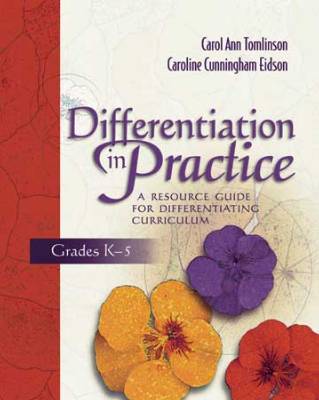
Differentiation in Practice

by Carol Ann Tomlinson and Caroline Cunningham Eidson

Table of Contents


Introduction

Readers read as they wish, of course, and there's great merit in that. We take away from a source what we are ready to take away, and we gather what we can find in accordance with how we learn best. We would not deny our readers this freedom even if we could. Nonetheless, we offer a few suggestions and questions to guide your learning from the units that follow:

  • See if you can find colleagues to read, analyze, and discuss the units with you.
  • Read all of the units—or at least several of them—not just ones that seem to address the grade level(s) you teach. Look for similarities and differences. Record what you see. What seem to be the non-negotiables in these units?
  • Think about how the unit developers have included and yet moved beyond mandated standards. What's the difference between “covering the standards” and the ways these teachers are using standards?
  • After you read and study a unit, go back to the list of standards reflected in the unit and the teacher's listing of what students should know, understand, and be able to do as a result of the unit. Check off those standards and goals you feel the unit addresses effectively. Develop ways to intensify the focus on any goals or standards you feel have not been addressed adequately.
  • Look for the links between the learning goals (the standards as well as what students should know, understand, and be able to do) and the individual lessons in each unit. In what ways have these teachers used the learning goals to design the specific steps in the units?
  • What benefits for students are likely to occur when a teacher organizes a unit by concepts rather than teaching a list of goals without one or more organizing concepts?
  • Think about students you teach. Name them in your head or on paper. Jot down ways in which these specific students might benefit from the differentiated units versus nondifferentiated versions of the same units. Think about students with a range of learning needs, including students who could be described as “typical.”
  • For which students in your class or classes would you need to make additional adaptations in order to facilitate optimal learning? How might you make these adaptations if you were to revise one of the units? Would it be easier to make the additional modifications in these differentiated units or in nondifferentiated ones?
  • How effective do you feel the various units are at
    • Beginning with sound curriculum prior to differentiating?
    • Making assessment a pervasive and useful element in instruction?
    • Providing respectful tasks for all learners?
    • “Teaching up”?
    • Using flexible grouping?
  • How did the teachers who developed these units seem to have decided when to use whole-class instruction and activities and when to differentiate instruction and activities?
  • Where in each unit might you incorporate additional ways to differentiate content for particular students in your class or classes? What about additional ways to differentiate process? Products? Which instructional strategies that your students currently enjoy using would you want to integrate into these units?
  • Where in each unit might you incorporate additional ways to address student readiness? Interest? Learning profile?
  • In what ways do these units call for flexible use of space? Of materials? Of time?
  • What classroom guidelines would you want to establish to ensure effective and efficient work in one or more of these units? How would you begin the process of developing a flexible but orderly learning environment in one of these classrooms? How might you enable your students to be your partners in establishing a flexible and differentiated classroom?
  • Think about connections between student affect and differentiation as it's reflected in these units. In what ways is the general classroom tone (where you teach) likely to impact student affect? Why? In what ways is the differentiation likely to impact student affect? Why? What connections do you see between student affect and student learning?
  • What is the role of the teacher in these differentiated classrooms compared with classrooms in which whole-class instruction predominates? What opportunities do teachers enjoy with flexible teaching that may not be so readily available in more traditional classrooms?
  • What portions of your own curriculum do you recognize in these units? In what ways can you build on what you already do in order to address the learning needs of your full range of students?
  • Which elements of these units do you particularly like? Which do you question? Talk with colleagues about what you see as positive in the units and what is less positive for you. In each instance, be sure to explore why you feel as you do.
  • Try adding your voice to a unit you have on paper, explaining why you have crafted the unit as you have—or why you might now think about modifying the unit in some way.
  • Be sure to apply in your classroom what you learn from the units in this book. It's wise to move at a pace and in a sequence that seems manageable to you—but it's important to grow as a teacher!

* * *

Our great hope, of course, is that you will be “stretched” by the time you spend with these six units. As educators, we invest our professional lives in the belief that learning is both dignifying and humanizing. We hope this will be your experience in the pages to come.


Table of Contents


Copyright © 2003 by Association for Supervision and Curriculum Development. All rights reserved. No part of this publication—including the drawings, graphs, illustrations, or chapters, except for brief quotations in critical reviews or articles—may be reproduced or transmitted in any form or by any means, electronic or mechanical, including photocopy, recording, or any information storage and retrieval system, without permission from ASCD.

MEMBER SIGN IN
Username or Customer ID
Password