

Countdown to Summer Conference
St. Louis, Mo.
July 1-3, 2012
  • membership
  • my account
  • help

    We are here to help!

    1703 North Beauregard Street
    Alexandria, VA 22311-1714
    Tel: 1-800-933-ASCD (2723)
    Fax: 703-575-5400

    8:00 a.m. to 6:00 p.m. Eastern time, Monday through Friday

    Local to the D.C. area, 703-578-9600, press 2

    Toll-free from U.S. and Canada, 1-800-933-ASCD (2723), press 2

    All other countries (International Access Code) + 1-703-578-9600, press 2

  • Log In


2012 Summer Conference

Learn about effective new programs and practices and join with colleagues in advancing a positive agenda for the future. July 1-3, St. Louis, Mo.


Permissions

ASCD respects intellectual property rights and adheres to the laws governing them. Learn more about our permissions policy and submit your request online.

Learning on Display

Learning on Display

by Linda D'Acquisto

Table of Contents

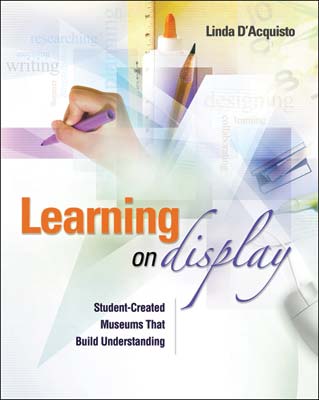
An ASCD Study Guide for Learning on Display: Student-Created Museums That Build Understanding

This ASCD Study Guide is designed to enhance your understanding of Learning on Display: Student-Created Museums That Build Understanding, an ASCD book written by Linda D'Acquisto and published in May 2006. It will help you make connections between the text and your personal and professional experiences. The author, a former classroom teacher, curriculum director, and museum educator, offers step-by-step advice and practical resources for transforming your curriculum into motivating museum projects.

You can use the study guide after you have read the entire book or as you finish each chapter. The questions provided are not meant to cover all aspects of the book; rather, they address selected ideas that might warrant further reflection. Most of the questions are ones you can think about on your own, but you might consider discussing your ideas with colleagues who are reading Learning on Display--or planning a school museum project.

The author invites you to share your ideas, examples, and questions about school museum projects with other teachers through her Web site, www.kidcurators.com. For more information about how to post your ideas, or if you have any questions or comments about this study guide or about the book, you may contact the author at ldacquisto@kidcurators.com.

Preface

  1. Describe one of the most meaningful, powerful, or memorable learning experiences you had during your K-12 education. What were the characteristics of that experience?
  2. D'Acquisto observes that "motivation for learning grew when students were engaged in work that had a real purpose, was created for an audience beyond the classroom teacher, and resulted in a tangible product" (pp. xi-xii). Think about the school experiences that have motivated your students the most. What were the characteristics of those experiences?

Chapter 1: Creating Student-Designed School Museums

  1. Review the list of interrelated activities on p. 6 and draw a graphic organizer to represent this "complete learning experience." What is the relationship among these activities in a school museum project? Which activity do you find most important? Most challenging?
  2. Visit the Partnership for 21st Century Skills Web site at www.21stcenturyskills.org to view the complete list of skills that students may need in order to function effectively in the workplace and global community. List the ways a school museum project would provide opportunities for students to practice each skill. If you decide to lead a school museum project, review and update this list after the museum opening.
  3. Review the Foxfire core principles on pp. 7-8. Which of these core principles is most important to you? Which ones are most important in your school? Select one principle that you would like to develop in your own practice and brainstorm how you might do so.
  4. Describe a professional learning experience that changed your practice in a large or small way. What was the ongoing learning component of this experience? How might you use the school museum process to create a similar professional development experience?
  5. D'Acquisto writes that "as teachers work with their team to create a rigorous project, they are engaged in an active form of project-based professional development that is often more powerful than workshops, study teams, or discussion groups alone" (p. 9). Write a project-based professional development plan for your school museum project or for any other long-term, rigorous project you might be planning for your classroom. Be sure to schedule reflective time to examine emerging student and teacher work.
  6. How might you use the school museum project to experiment with and refine the following practices: research-based instruction, standards-based curriculum design, student-involved assessment, differentiation, and working as a collaborative professional learning community?

Chapter 2: Collaborating to Develop Museum Projects

  1. Think about a recent example of teamwork in your classroom or in your school. How did the team members collaborate? What went well? What could have gone better? Did the team members need one another to accomplish a result?
  2. On p. 12, the author states that "school museum projects are not science fairs." Explain why.
  3. Outline ways in which team members can function interdependently as they lead a project (see the Bayside example on pp. 13-14). Which collaboration model would work best in your school?
  4. Brainstorm ways in which parents can become involved in your school projects. If you're planning a school museum, adapt the parent letter on p. 17 to incorporate your ideas.
  5. Prepare a list of community members and community organizations that might be a resource for your school museum project or for other projects in your school. How might you solicit support from these people and groups?

Chapter 3: Clarifying What Students Will Learn

  1. Review the various approaches for selecting a school museum project and brainstorm two or three curriculum-related ideas for each category. When your list is complete, evaluate each option using the "topic" portion of the rubric on pp. 26-27.
  2. Select one of your ideas for a school museum project and practice writing a big idea for the topic (see pp. 31-32). Evaluate your big idea using the first descriptor under the "content" portion of the rubric on p. 26. How might you improve your big idea?
  3. Brainstorm a list of misconceptions you believe students may have regarding this school museum topic. How might you address these misconceptions? If you are planning to lead a museum project on this topic, conduct the "know and wonder" activity with your students and compare its results to your list.
  4. Consider the benefits of hosting a parent and community affinity diagramming session early in the planning stages of your school museum project. How might you organize the event? What challenges do you anticipate?
  5. Reread the quote on p. 36 from Schauble, Leinhardt, and Martin (1997). Describe a time when it was easier for your students to "mentally organize information effectively" because it was "recounted to them in a story."
  6. Consider the last instructional unit you taught. Did it have a big idea? Story line? How would that unit have to change to enable you to write a big idea and story line with more ease?
  7. Review the project planning rubric on pp. 26-27. List the trait that you feel will be the most challenging to implement well. Develop several strategies for addressing these concerns.

Chapter 4: Assessing Student Learning

  1. How might clear learning targets improve student motivation throughout the school museum project? How might you organize a portfolio system that shows student growth toward these learning targets?
  2. Review the sample learning targets for a school museum project (p. 45). If the targets are not written in language your students will understand, use the "I can" process described on p. 46 to rewrite the targets for your students. Are there additional targets you think your project needs to address?
  3. Consider the grading plan on p. 50. How might you adapt this plan for use in your school museum project? How might you use the grading plan format for other instructional units?
  4. Do you agree with D'Acquisto's observation that "providing opportunities for formative, student-involved assessment will improve student performance" (p. 51)? Why or why not? What types of formative assessment have been most and least useful in your classroom? Brainstorm new ways for helping students envision and achieve high-quality work. If you're planning a school museum, review the strategies in Appendix B for each step and list those you'd like to incorporate into your project.
  5. How do students in your classroom self-assess their work? How do you provide descriptive feedback to students? Would the three-minute conference form developed by Stiggins, Arter, Chappuis, and Chappuis (2004) work well with your students (see Figure 4.4 on p. 56)? Why or why not? How might you integrate this tool in the school museum project?
  6. Using one of Barell's (2003) open-ended writing prompts on p. 58, take a few minutes to self-assess your own progress toward understanding how a school museum project can affect student learning. Then think about how you might use reflective writing with your students throughout the school museum project.
  7. Review the assessment plan rubric on p. 44. List the trait that you feel will be the most challenging to implement well. Develop several strategies for addressing these concerns.

Chapter 5: Introducing the Museum Project

  1. Think carefully about each of the eight steps in the school museum process, outlined on pp. 64-65. Which step do you think will be easiest to carry out in your classroom? Which step will be most challenging? Which part of the project are you looking forward to the most?
  2. Brainstorm ways in which you might introduce the school museum project to your students. How might a simple kickoff activity build enthusiasm for the project? How might you provide your students with needed background knowledge before starting the project? What is the best way for your students to "meet the problem"?
  3. When you think of museums, what kinds of informal learning environments come to mind? What objects and images can be found in each environment? Think about how each environment might provide a useful model for your school museum.
  4. List the "artifacts" that were generated during your last instructional unit. Group these artifacts so they tell the story of that unit. Could these items become the basis for a mini-display? How might this activity help your students better understand the unit as a whole?
  5. How well do your students work in teams? Do they know how to be good team members? What team roles and responsibilities work best with your students? Brainstorm strategies to help build the collaborative skills of your students before they work on an exhibit team (see pp. 78-80 for one idea).
  6. How might front-end evaluation be useful as a strategy to engage your community in the school museum project and address community needs?
  7. Review the instructional process rubric on pp. 66-67. List the trait that you feel will be the most challenging to implement well. Develop several strategies for addressing these concerns.

Chapter 6: Visiting a Professional Museum

  1. Brainstorm a list of professional museums your students might visit as part of the school museum project. Consider what each museum offers in terms of high-quality models of professional work and select the most appropriate choice for your class field trip.
  2. Recall a high-quality exhibit you've visited and use the observation guide on p. 85 to list the characteristics that made that exhibit excellent. Or better yet, visit a local museum to practice using the observation guide. You might also want to use the exhibit design rubric on pp. 116-117 to evaluate this professional exhibit.
  3. Evaluate whether your students will understand the questions on the observation guide. How might you modify the guide for your students? What might you add?
  4. Contact a local museum educator or exhibit developer to learn about the guidelines he or she uses in developing and evaluating exhibits.

Chapter 7: Researching the Museum Topic

  1. Review your school's research curriculum. How might this curriculum be integrated into your school museum project?
  2. Create a web of information sources for your school museum topic (see p. 96 for an example). Include sources such as print material, Web sites, individuals in your community, DVDs, local and national organizations, community sites, objects and images, and museums.
  3. Review the different summarization and note-taking techniques on pp. 103-105. Compare these to the strategies presented in your school's language arts or research curriculum. Select the strategies that you will teach students during the research phase of the school museum project.
  4. D'Acquisto discusses the use of a research write-up and graphic organizer to help students analyze their research findings and answer their research questions. Compare these analysis strategies to those presented in your school's language arts or research curriculum. Select the strategies that you will teach students during the research phase of the school museum project.
  5. A research write-up and graphic organizer can also be used to help students synthesize their individual research findings and answer their team focus question. Compare these synthesis strategies to those presented in your school's language arts or research curriculum. Select the strategies that you will teach students during the research phase of the school museum project.
  6. Students write a big idea and a story line (or visitor learning goals) for their individual exhibit, just as teacher planners do for the full exhibition. Examine a photo or description of one student-created exhibit in this book and write the big idea and story line you think the student exhibit team had in mind. Does the story line include affect and action goals as well as knowledge goals? If not, what affect and action goals might you add?

Chapter 8: Designing the Exhibits

  1. Think about your upcoming school museum topic and imagine one exhibit that might be included in the final exhibition. What objects and images would you need if you were to tell the story without words?
  2. Prepare a list of exhibits that your colleagues and friends have visited and ask them how these exhibits were designed. When you have 10 exhibits on your list, categorize them in terms of the presentation methods listed on p. 121. Then use the SCAMPER strategy (see pp. 122-123) to trigger design ideas for a school museum project.
  3. Examine Tilden's (1977) principles of interpretation on p. 125. How could these principles help students think about ways in which visitors might experience their exhibit? On a different note, how do Tilden's principles relate to teaching and learning in the classroom? If curriculum content is the equivalent of the exhibit, the student is the equivalent of the visitor, and the teacher is the equivalent of the interpreter, how might these principles help teacher interpreters create a bridge between the student and the content?
  4. Think about professional exhibits you've seen that successfully related to visitors' personal experiences or engaged visitors' senses. Review the examples on pp. 125-128 for additional ideas to use in your museum project.
  5. Review the inexpensive display solutions listed on pp. 129-130 (and pictured on p. 131). What might work in your school museum's space and for your school museum's topic?
  6. What is the value of having students conduct formative evaluation of their prototype exhibits or exhibit drawings? How might this process help your students with exhibit design?

Chapter 9: Writing for a Museum Audience

  1. Review Serrell's (1996) 10 "deadly sins" of label copy on pp. 135-136. Have you encountered all these "sins" while reading label copy in museums? Which ones have you encountered most often? How might a review of this list help your students understand the features of effective and ineffective label copy before they begin writing?
  2. Visit a museum next weekend and take digital photos of text panels, if possible. (Museums have different policies on photographing exhibits, so be sure to consult museum staff before taking pictures.) Evaluate the professional label copy using the rubric on pp. 138-139. How might this activity help students understand the traits of effective label copy?
  3. Review the strategies on p. 137 for making label copy relevant to visitors. Were any of these strategies used in the examples of label copy you collected? How might you revise those professional examples to make them more relevant and meaningful? How might this activity help your students write label copy that is more effective?

Chapter 10: Constructing the Exhibition

  1. How might you emphasize student learning in terms of teamwork, organization, responsibility, visual and spatial awareness, artistic sensibility, and the like throughout the construction phase of the museum project?
  2. Think about times when your students have engaged in hands-on learning projects. How were you able to keep students on task? What discipline problems, if any, arose? Were there students who surprised you with their skill or interest in the project? What were the benefits of the hands-on approach?
  3. Review the construction planning worksheet (p. 150) and the materials, supplies, and equipment worksheet (p. 151). How can these tools help your students organize for construction? What other organizational tools might they need?
  4. Consider the benefits of inviting community members to participate in an "installation day." If you are leading a school museum project, contact your PTO president to see if he or she will assist in planning this day and making it a fun and festive community event.

Chapter 11: Learning the Full Exhibition

  1. How can students use the time before the museum opening to learn the full exhibition and the content of the exhibits they did not develop?
  2. Review your project plan, specifically the statements of expected student learning--they represent the complete list of concepts students should understand by the end of the project. Plan several learning activities prior to the public opening to help students learn the content of the entire exhibition, especially for exhibits they didn't personally develop.
  3. Review the interpretation worksheet on p. 156. How might you adapt this for your students? How might you help students summarize the key points of their exhibit and develop "hooks" to engage visitors?
  4. Develop a plan for administering the summative assessments outlined in your grading plan.

Chapter 12: Opening the Museum to the Public

  1. What is the value of scheduling an evening event that is open to the general public? How might such an event heighten student interest in the project from the outset and provide purpose for students' work? What benefits would come from the public visiting your completed exhibition?
  2. Review the student roles for opening night (pp. 161-163) and decide which roles you would like your students to play during your event. Develop a schedule that lists the responsibilities of each student (see pp. 168-169).
  3. Review the list on p. 163 of possible activities for your opening night. How might you involve your students in selecting activities to plan and host? How might you help your students get organized for the event?
  4. Brainstorm ways to advertise your opening event to parents, community members, professional organizations, media outlets, and the like. How might your museum topic guide your advertising decisions?
  5. How might you use the exhibition after it is dismantled? How might other teachers in your school or district use it for teaching and learning?
  6. What are the best ways to celebrate students' accomplishments? How might you acknowledge your students after the museum is dismantled?

Afterword

  1. List your hopes and fears for your school museum project or any upcoming project. Brainstorm ways in which you are likely to realize your hopes and avoid your fears.
  2. If you're planning to lead a museum project, review the ideas you've generated and decide which ones you will pursue.

Learning on Display was written by Linda D'Acquisto. This 191-page, 7 7/8" x 9 7/8" original paperback book (Stock #105018; ISBN-13 978-1-4166-0285-9; ISBN-10 1-4166-0285-2) is available from ASCD for $21.95 (ASCD member) or $27.95 (nonmember). Copyright © 2006 by ASCD. To order a copy, call ASCD at 1-800-933-2723 (in Virginia 1-703-578-9600) and press 2 for the Service Center, or buy the book from ASCD Online Store.

Table of Contents

Copyright © 2006 by Association for Supervision and Curriculum Development. All rights reserved. No part of this publication—including the drawings, graphs, illustrations, or chapters, except for brief quotations in critical reviews or articles—may be reproduced or transmitted in any form or by any means, electronic or mechanical, including photocopy, recording, or any information storage and retrieval system , without permission from ASCD.


Loading Comments...