
Countdown to Annual Conference
San Antonio, Tex.
March 6-8, 2010
Home
MISSION: ASCD (formerly the Association for Supervision and Curriculum Development) is a membership organization that develops programs, products, and services essential to the way educators learn, teach, and lead.
We are here to help!
1703 North Beauregard St.
Alexandria, VA 22311-1714

Tel: 1-800-933-ASCD (2723)
Fax: 1-703-575-5400

8:00 a.m. to 6:00 p.m. EST Monday through Friday

Local to the D.C. area:
703-578-9600, press 1

Toll-free from the U.S. and Canada: 1-800-933-ASCD (2723), press 1

All other countries (International Access Code): +1-703-578-9600, press 1
Permissions and Translations
ASCD recognizes and respects intellectual property rights and adheres to copyright law. Learn about our rights and permissions policies.


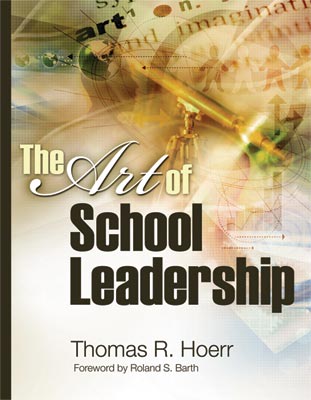
Art of School Leadership

by Thomas R. Hoerr

Table of Contents


Introduction

Strong leaders are artists. They inspire, applaud, chastise, steer, and stand on the side. They create, monitor, reinforce, encourage, and stand in the back. Yes, sometimes they stand in front, too. They recognize that it is their responsibility to help create a setting in which each individual can flourish and everyone can grow. Strong leaders understand that leadership is about relationships.

Strong leaders are artists because they recognize that there is no one formula, no particular policy, no set of procedures that will always work with everyone or, even, will always work with any one person. Each unique situation and every idiosyncratic individual must be appreciated. We know that we must take a developmental approach to how our students learn; we also know that they learn best when they learn constructively, by creating their own meaning. It is no different for our teachers. They, too, must be viewed developmentally; they, too, learn best constructively. I believe that this is true of leaders and followers everywhere, in all settings, and I am sure that it is even more true of leaders in schools.

As I write this introduction, I am nearing my 28th year of leading a school. This longevity means that I have made many mistakes. I hope that I have learned from these mistakes. I certainly don't lack opportunities to learn, those times when I look back and see what I should have done differently or what I should do in the future. Just last week, for example, an entire inservice day was allocated for teachers to meet individually with administrators to discuss their professional goals. The day consisted of a series of 30-minute meetings, one after the other, after the other. I was beat at the end of the day, but I was also invigorated. It was exciting to hear the teachers' plans and to have an uninterrupted half hour to talk and learn with each of them. At the end of the day, all I could think was, Why didn't I do this before?


Throughout this book you'll find leadership advice from educators around the world. 


We are all leaders, and we are all learners. ~Tamala 


This book capitalizes on my experiences, what worked and what didn't, and offers ideas and examples for how a school can be led. I also e-mailed many educators around the world and asked for their thoughts on the issues I was addressing. You'll see many of their comments in the margins of these pages. Leadership is an art, so there are no formulas. Instead, chapters deal with the day-to-day stuff that administrators live and breathe: running meetings, evaluating teachers, working with parents, building a team, supervising projects, focusing on diversity, and encouraging collegiality.

I believe that the challenges facing school leaders are greater than those facing leaders in other arenas. This stems from the nature of education and how our schools are organized. Three particular challenges quickly come to mind.

  • Balancing measurement tensions. In for-profit organizations, the outcomes are agreed upon and the bottom line is very clear. Educators, however, continue to debate how to measure success in schools. Should individual students, groups of students, or an entire school be evaluated only on the basis of standardized tests? What about primarily on standardized tests? What aspects of student growth aren't captured by any standardized test? Does “adequate yearly progress” offer a more realistic picture of what we can expect from our students and ourselves? How can PEPs (projects, exhibitions, and presentations) and portfolios be used to gauge student growth? Can these measures be used to accurately gauge teacher effectiveness?
    Even though debates continue to rage about the validity of such instruments, and perceptive educators realize that objective tests capture only slices of a student's growth, principals are held accountable for the performance of their schools on standardized measures. Principals must focus their energies and those of their staffs on what is being measured, regardless of any misgivings they might hold about the limitations of the measurement tools. But it is not this simple. At the same time, principals must also realize that other issues are critically important to student and faculty growth and development.
  • Herding cats. Leading teachers has been likened to conducting a symphony orchestra, coaching a basketball team, or herding cats. A conductor works at getting each member of the orchestra to play an instrument in concert with all the other members; success is determined by how well they play together. A basketball coach creates relationships in which players feed off one another and adjust to the changing tempo of the game; success is determined by how well they play together. Good leadership enables the players, whether in the orchestra or on the basketball team, to achieve more as members of the group than they ever could as individuals. A cat herder keeps the goal in mind and recognizes that it will never be easy; he often asks himself, “Why am I doing this?”
    Leadership never is easy, and it's even harder to lead the kinds of people we want to teach our students. That is because many of the qualities that are found in wonderful teachers—passion, creativity, and a thirst for independence—can make it difficult for them to share, to work toward a common goal, and to be good teammates. This tendency is exacerbated because teaching is often a very autonomous activity (it shouldn't be, of course, and that is the focus of much of this book). Indeed, it can sometimes be hard for teachers to accept the fact that they have a boss.
    For talented teachers, teaching is an art and they are artists. When I think of these teachers, I use Michelangelo as my avatar. We want Michelangelos teaching our children, yet Michelangelos are often difficult, recusant, and quite independent, and they can be difficult to lead. We must find ways to lead that inspire and challenge as well as direct and support. Supervising Michelangelo is no small task.
  • Being caught in the middle. Principals answer to just about everyone. Officially, they are responsible to a superintendent and assistant superintendents. They are also, officially or otherwise, responsible to associate superintendents, assistants to the superintendent, deputy superintendents, area superintendents, directors of education, and curriculum directors. Let's not forget board of education members, who sometimes have difficulty recognizing what is policy and what is administration. Clearly, principals have multiple official bosses. (Some principals would add that they are responsible to the director of transportation or the director of building and grounds!)


Leaders challenge, but they do not overwhelm. ~Nelly 


Principals are also responsible to their teachers, who play the role of unofficial bosses. Leading schools involves creating an environment in which everyone grows, including the teachers and the principal. In that environment, principals listen to teachers, and listening implies a willingness to respond. In addition, some teachers will have more experience and clout with parents (or maybe with people who work in the central office) than does the principal. Unhappy teachers can rally parents; satisfied teachers can quell them. Teachers' unions have also given teachers a strong voice in many management issues.

Of course, principals also answer to parents. Three unhappy parents can cause a revolt. Two dissatisfied parents can create endless headaches. One malcontent parent can get an audience with the superintendent. And as any principal knows, critical and unhappy parents will be found in every school, no matter the quality of the school or the skill level of the principal. Principals must work to educate and include all parents.

These unique challenges endemic to leading a school—the debate over how student and school progress can be measured, the issue of teachers as artists, and the visible and vulnerable nature of the role of the school leader—take us to one inescapable conclusion: Leadership is about relationships. Indeed, sometimes those relationships are quite close and intimate; at other times, they extend across countries and continents. The quotes that you see in the margins of this book, for example, are from educators around the world. Although I personally know some of these individuals, the majority are people with whom I've had “only” an ongoing e-mail relationship. Nevertheless, these are educators from whom I have learned.

Good leaders embrace these challenges and move schools forward. Whether a school is progressing from struggling status to acceptable or going from acceptable to good or moving from good to great, leadership is the key variable in its evolution.


Table of Contents


Copyright © 2005 by Association for Supervision and Curriculum Development. All rights reserved. No part of this publication—including the drawings, graphs, illustrations, or chapters, except for brief quotations in critical reviews or articles—may be reproduced or transmitted in any form or by any means, electronic or mechanical, including photocopy, recording, or any information storage and retrieval system, without permission from ASCD.

MEMBER SIGN IN
Username or Customer ID
Password