
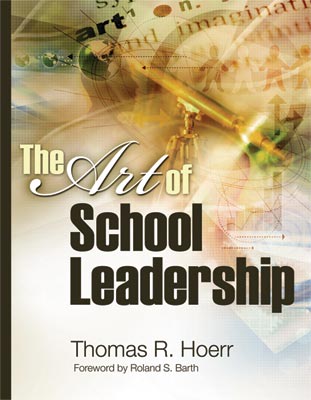
by Thomas R. Hoerr
In addition to the References, the following resources were helpful to me in thinking about the issues addressed in this book.
Brown, E. (2004, December 12). Can for-profit schools pass an ethics test? New York Times, p. B5.
Collins, J. (2001). Good to great: Why some companies make the leap—and others don't. New York: HarperBusiness.
Evans, R. (1996). The human side of school change: Reform, resistance, and the real-life problems of innovation. San Francisco: Jossey-Bass.
Fullan, M. (2001). Leading in a culture of change. San Francisco: Jossey-Bass.
Gardner, H. (1996). Leading minds: An anatomy of leadership. New York: Harper-Collins.
Gittell, J. (2003). The Southwest Airlines way: Using the power of relationships to achieve high performance. New York: McGraw-Hill.
Gladwell, M. (2000). The Tipping Point. Boston: Little & Brown.
Goodwin, B. (2002). In the shadow of culture. In J. Brockman (Ed.), The next fifty years (pp. 41–51). New York: Vintage Books.
Hirsch, E. D. (1988). Cultural literacy: What every American needs to know. New York: Vintage Books.
Inclusion Network. (n.d.). Retrieved May 10, 2005, from www.inclusion.org
Lambert, L., Walker, D., Zimmerman, D., Cooper, J., Lambert, M., Gardner, M., & Slack, P. (1995). The constructivist leader. New York: Teachers College Press.
Micklethwait, J., & Wooldridge, A. (1996). The witch doctors: Making sense of the management gurus. London: Random House.
Putnam, R. (2000). Bowling alone: The collapse and revival of American community. New York: Simon & Schuster.
Sarason, S. (1999). Teaching as a performing art. New York: Teachers College Press.
Stewart, T. (1997). Intellectual capital: The new wealth of organizations. New York: Doubleday/Currency.
Surowiecki, J. (2004). The wisdom of crowds: Why the many are smarter than the few and how collective wisdom shapes business, economies, societies, and nations. New York: Doubleday.
Copyright © 2005 by Association for Supervision and Curriculum Development. All rights reserved. No part of this publication—including the drawings, graphs, illustrations, or chapters, except for brief quotations in critical reviews or articles—may be reproduced or transmitted in any form or by any means, electronic or mechanical, including photocopy, recording, or any information storage and retrieval system, without permission from ASCD.