
Countdown to Annual Conference
San Antonio, Tex.
March 6-8, 2010
Home
MISSION: ASCD (formerly the Association for Supervision and Curriculum Development) is a membership organization that develops programs, products, and services essential to the way educators learn, teach, and lead.
We are here to help!
1703 North Beauregard St.
Alexandria, VA 22311-1714

Tel: 1-800-933-ASCD (2723)
Fax: 1-703-575-5400

8:00 a.m. to 6:00 p.m. EST Monday through Friday

Local to the D.C. area:
703-578-9600, press 1

Toll-free from the U.S. and Canada: 1-800-933-ASCD (2723), press 1

All other countries (International Access Code): +1-703-578-9600, press 1
Permissions and Translations
ASCD recognizes and respects intellectual property rights and adheres to copyright law. Learn about our rights and permissions policies.


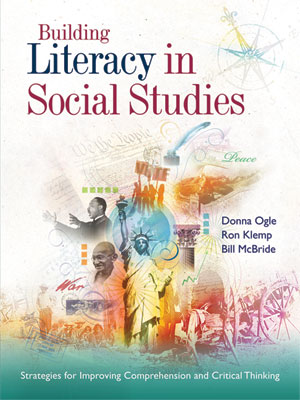
Building Literacy in Social Studies

by Donna Ogle, Ron Klemp and Bill McBride

Table of Contents


Preface

I know of no safer depository of the ultimate powers of the society but the people themselves; and if we think them not enlightened enough to exercise their control with a wholesome discretion, the remedy is not to take it from them, but to inform their discretion by education.

Thomas Jefferson

Our students will soon be the citizens making decisions that will influence the direction of the world. The future is in their hands; their sensitivity to the variety of cultures and perspectives that influence the course of history will be critical as members of a global community. Yet, if current trends continue, few of our students will become active citizens in our democratic society. The percentage of eligible voters in the United States who take part in their civic responsibilities is embarrassingly low for such a wealthy country with universal public education. As astronaut John Glenn and Leslie Hergert note in Carl Glickman's book Letters to the Next President: What We Can Do About the Real Crisis in Public Education (2004):

Today, American citizens are more educated than ever before—a larger percentage attend school longer—yet, civic involvement is on the wane. As adults' civic involvement has declined, so has that of the nation's youth, and at even sharper rates of decline. Numerous studies have documented youth's low voter participation rate, negative opinion of elected officials, and general alienation from government and politics. Young people have learned apathy, not engagement. (p. 202)

Part of the responsibility placed on social studies teachers is to give students the skills and motivation to become informed citizens. Many students, however, care little about studying civics, government, or history. We are acutely aware that teachers are having a difficult time getting students to actively read and reflect on materials provided for the development of their knowledge about social studies themes and topics. This book will provide both the conceptual basis and the classroom strategies to help teachers actively engage their students in developing the skills needed to become informed citizens. As Grant Wiggins and Jay McTighe (2005) note, students need to be examining big ideas of “enduring understandings.” Students need to be engaged in problems that matter to them and that have more than one solution or right answer. Thus it is vitally important that students learn to use a variety of sources to develop concepts about our society, government, and history. Students need to learn to work collaboratively and cooperatively on meaningful projects, regularly connecting what they are learning to their own communities and to world events. They need strategies to help them think critically about what they read, what they hear in and outside of school, and what they view in the media. Taking action is a natural impulse for adolescents that can be nurtured to help them become involved citizens.

Social studies teachers have unusual opportunities now to introduce students to a wide variety of materials in addition to textbooks. Computer technology and the Internet provide a wealth of visual and firsthand information for their use. Electronic resources available through the Library of Congress, for example, can invite reluctant learners into the reality of American history with photographs, posters, songs, and primary documents from the past. The availability of these primary source documents adds to the possibilities for teachers and students. With more materials available comes the opportunity to help students develop critical reading and thinking skills through document-based questions. By comparing interpretations and information in different materials, students can learn to look for accurate sources and develop understandings of different points of view.

Building Literacy in Social Studies is a sourcebook of research-based strategies for teachers and students. Chapters 1 through 5 provide research and strategies on the reading process, on fostering engaged learning, on vocabulary development for older students, on classroom organization, and on civic engagement. Each of these five chapters begins and ends with a fictitious scenario of a social studies teacher teaching today's students. At the beginning of each chapter, this teacher demonstrates ineffective strategies for helping students become engaged in learning. At the end of the chapter we bring the teacher back; however, this time he models some of the specific strategies discussed in the chapter. The addition of these scenarios enlivens the text and also shows readers how effective strategies can transform their classrooms.

The format of the book changes with Chapter 6. The last three chapters provide specific literacy strategies for students in the areas of textbook literacy, primary and secondary documents, and newspaper and magazine literacy. A number of practical and engaging strategies are provided in each of these areas. Each strategy presented includes the following four elements: (1) instructions that explain to the teacher how to model the strategy; (2) instructions that explain to the student how to perform the strategy; (3) a completed model or graphic organizer of the strategy; and (4) a blank model or graphic organizer for teacher and student use.

Alexis de Tocqueville noted that “there is nothing more arduous than the apprenticeship of liberty.” Creating informed, engaged citizens is arduous work. To be critical thinkers, students must be critical readers. To be critical readers, they must first be literal readers. This book presents research-based tools to help students understand the varied materials that represent past and present events; analyze, synthesize, and evaluate these materials; and most important, reflect on and make informed decisions as active citizens in today's democracy.


Table of Contents


Copyright © 2007 by Association for Supervision and Curriculum Development. All rights reserved. No part of this publication—including the drawings, graphs, illustrations, or chapters, except for brief quotations in critical reviews or articles—may be reproduced or transmitted in any form or by any means, electronic or mechanical, including photocopy, recording, or any information storage and retrieval system, without permission from ASCD.

MEMBER SIGN IN
Username or Customer ID
Password