Countdown to Annual Conference
San Antonio, Tex.
March 6-8, 2010
Home
MISSION: ASCD (formerly the Association for Supervision and Curriculum Development) is a membership organization that develops programs, products, and services essential to the way educators learn, teach, and lead.
We are here to help!
1703 North Beauregard St.
Alexandria, VA 22311-1714

Tel: 1-800-933-ASCD (2723)
Fax: 1-703-575-5400

8:00 a.m. to 6:00 p.m. EST Monday through Friday

Local to the D.C. area:
703-578-9600, press 1

Toll-free from the U.S. and Canada: 1-800-933-ASCD (2723), press 1

All other countries (International Access Code): +1-703-578-9600, press 1
Permissions and Translations
ASCD recognizes and respects intellectual property rights and adheres to copyright law. Learn about our rights and permissions policies.


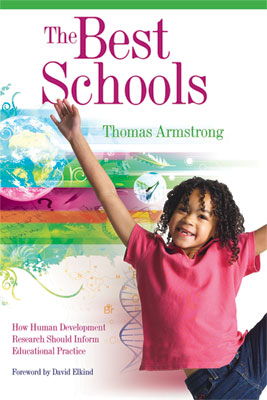
Best Schools

by Thomas Armstrong

Table of Contents


Foreword

What is the aim of education? Is the primary goal of schooling to train young people to pass tests and get good grades, or is it, as Jean Piaget once put it, “To train young people to think for themselves and not to accept the first idea that comes to them.” This is the issue addressed in this powerful and important book. Armstrong argues that these two aims reflect different educational discourses that guide and direct pedagogical values, thoughts, and practices. One of these discourses, the Academic Achievement Discourse (mightily aided and abetted by the No Child Left Behind legislation), currently dominates the educational scene. The alternative, Human Development Discourse, is found in some public, charter, and private schools that adapt their curricula to the developing needs, interests, and abilities of the students. Schools that implement the Human Development Discourse are what Armstrong refers to as The Best Schools.

To make his case against Academic Achievement Discourse, Armstrong gives a brief history of this orientation and then lists 12 negative consequences of this type of pedagogy. Some of these negative consequences, like teaching to the tests, and inadequate attention to individual, cultural, and ethnic differences, are familiar critiques of the No Child Left Behind agenda. When all of these negative consequences are brought together in one place, however, the overall impact is so strong, one has to question why this dysfunctional educational discourse is so dominant. The answer is, of course, that what we do in our schools has nothing to do with what we know is effective pedagogy for children. Rather, what we do in our public schools is largely determined by social, political, economic, and cultural considerations. The best interests of children are too often left behind.

In parallel with his critique of the Academic Achievement Discourse, Armstrong presents a brief history of the Human Development Discourse and lists 10 positive consequences of this pedagogical orientation. Again, many of the arguments for a human development approach to education are familiar. These include the enabling of all students to realize their individual patterns of strengths and abilities, and allowing students to take control of their learning environment. Armstrong argues that while the quantitative test results of Academic Achievement Discourse offer educators a quick and easy way to document the results of instruction, the benefits of Human Development Discourse are long-term and best expressed in qualitative assessments that have equal or greater validity as methods for evaluating learning progress.

In the remaining sections of the book, Armstrong gives illustrations of how the Human Development Discourse can be put into practice at the preschool, elementary, middle, and high school levels. Armstrong describes what should be the central focus of pedagogy at each level. At the preschool level, education should evolve out of the child's play. That is to say, at this stage learning is largely inner-directed and the early childhood educator can build the curriculum around and through children's spontaneous interests. Elementary education, according to Armstrong, should focus on helping children understand how the world works by actively engaging them in real-life activities. Middle schools, when children are attaining second-order reasoning skills, should emphasize social, emotional, and metacognitive growth. Finally, high schools should be devoted to preparing students to live independently in the real world.

In these last chapters of the book, Armstrong gives many practical suggestions and guidance for developmentally appropriate practice at each of the four levels of education. He also gives examples of Academic Achievement practices that should be avoided. These last chapters are what make this book different from those that deal with either theory or classroom matters. Armstrong is both an academic and a practitioner and he is able to translate the theoretical assumptions of the Human Development Discourse into practical teaching strategies and practices. As such this book is a much needed guide to the Human Development Discourse and to its application across the K–12 educational spectrum.

David Elkind


Table of Contents


Copyright © 2006 by Thomas Armstrong. All rights reserved. No part of this publication—including the drawings, graphs, illustrations, or chapters, except for brief quotations in critical reviews or articles—may be reproduced or transmitted in any form or by any means, electronic or mechanical, including photocopy, recording, or any information storage and retrieval system, without permission from ASCD.

MEMBER SIGN IN
Username or Customer ID
Password