

Countdown to Annual Conference
San Antonio, Tex.
March 6-8, 2010
Home
MISSION: ASCD (formerly the Association for Supervision and Curriculum Development) is a membership organization that develops programs, products, and services essential to the way educators learn, teach, and lead.
We are here to help!
1703 North Beauregard St.
Alexandria, VA 22311-1714

Tel: 1-800-933-ASCD (2723)
Fax: 1-703-575-5400

8:00 a.m. to 6:00 p.m. EST Monday through Friday

Local to the D.C. area:
703-578-9600, press 1

Toll-free from the U.S. and Canada: 1-800-933-ASCD (2723), press 1

All other countries (International Access Code): +1-703-578-9600, press 1
Permissions and Translations
ASCD recognizes and respects intellectual property rights and adheres to copyright law. Learn about our rights and permissions policies.


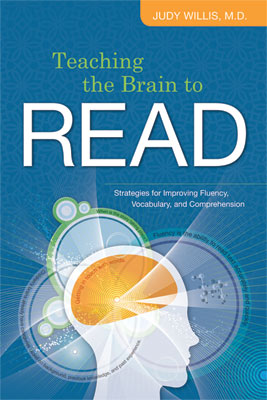
Teaching the Brain to Read

by Judy Willis

Table of Contents


Introduction

On a hot day, after a climb up a few hundred steps in a historic lighthouse on the Oregon coast, I was weary but ready for the next adventure. I was motivated because I knew it was worth climbing those stairs for the view from the top. In the parking lot I heard a boy of about 5 complain to his parents in the overtired and frustrated whine any parent or teacher recognizes. He didn't want to go to any more lighthouses. They were "stupid and boring," so why should he have to go? As the child became more angry and resistant, his parents suggested that he could sit in the car and calm down and then they could continue the discussion. This boy knew what that meant. He knew there would be no discussion and he would have no say in the outcome, so he just snapped and said, "Sitting isn't leaving!"

The emotions he was feeling are much like those of children who struggle with learning to read and later learning to understand complex text. The frustration, the anxiety about making mistakes, and the impatience build and build as teachers and parents try to coerce the child to climb the lighthouse steps that are the "must-know spelling words."

Reading comes easily to some children, but most struggle with some part of the complex process that begins with phonemes and continues to comprehension of complex text. When students are asked to face stressful reading challenges, they don't feel good about the reading equivalent of a hot day and a daunting staircase. They will be resistant when the task they are asked to do is either not at their skill level or so unmotivating that they can't or won't persevere. They also don't necessarily value the reward, be it the view from the lighthouse or the reading of a book. They may not think that there is any purpose in struggling to read when they can enjoy stories and even acquire information from videos, movies, television, and being read to. Asking a child to just suck up reading frustration won't work.

Reading is not a natural part of human development. Unlike spoken language, reading does not follow from observation and imitation of other people (Jacobs, Schall, & Scheibel, 1993). Specific regions of the brain are devoted to processing oral communication, but there are no specific regions of the brain dedicated to reading. The complexity of reading requires multiple areas of the brain to operate together through networks of neurons. This means there are many potential brain dysfunctions that can interfere with reading.

Considering all the cognitive tasks required to go from connecting symbols to sounds, sounds to words, words to meaning, meaning to memory, and memory to thoughtful information processing, it is not surprising that an estimated 20 percent to 35 percent of American elementary through high school students experience significant reading difficulties (Schneider & Chein, 2003).

I am filled with awe and respect for every teacher who has helped a student climb the lighthouse stairs by using successful strategies and motivators. Without these teachers, children would never discover that the view from the top is so wonderful.

The Development of Brain-Based Research

The two most important advances in brain-based research are positron emission tomography (PET) and functional magnetic resonance imaging (fMRI). The PET scan relies on one of the brain's properties; it is extremely hungry for glucose and oxygen. PET scans measure the metabolism of glucose in the brain in response to certain activities. In this technique, positron–emitting isotopes, which function as radioactive tracers, are injected into the arteries in combination with glucose. The rate at which specific regions of the brain use the glucose is recorded while the subject is engaged in various sorts of cognitive activities. These recordings are used to produce maps of areas of high and low brain activity with particular cognitive functions.

The technology behind fMRI is similar to that of MRI. However, fMRI takes advantage of a special property of hemoglobin, a blood protein that brings oxygen to body tissues. Hemoglobin that is carrying oxygen has different properties from hemoglobin that is not carrying oxygen. By detecting oxygen-containing hemoglobin, scientists use fMRI to assess changes in blood flow to areas of the brain. Active regions of the brain receive more blood and more oxygen.

Specifically, fMRI has been prominent in revealing the neural mechanisms for reading in children. The PET scans have limitations because of radioactivity of the isotope used in the tracer material injected. The fMRI is completely painless, does not involve radiation, and is also faster. It does have the problem of being very loud, but researchers have found that if they precondition children to the drum-like knocking sounds they will hear during the scan by having them listen to these sounds on earphones and also have them wear earplugs during the scan (average time 10 minutes) the children become comfortable with the procedure.

Brain-based learning research has given and will continue to give educational researchers neuroimaging data to help correlate classroom strategies to brain activity during the stages of learning. During the next decades, the neuroscience of learning will continue to provide data that neurocognitive researchers can use to develop and test classroom strategies for teaching the many components of reading.

What Research to Trust?

The increasing scientific knowledge about the physiology of how the human brain learns has the potential to significantly impact classroom instruction. For educators to take an informed leadership role on issues regarding the teaching of reading that are derived from brain research, we must understand the research, be able to evaluate the accuracy, credentials, and potential for bias in the so-called experts who interpret it, and find ways to develop and use strategies based on valid research to improve student success in reading.

The stated goal of much education legislation is for all students to learn to read. The goal of most educators extends beyond that—for students to learn not only the mechanics of reading and reading comprehension, but to also to develop a love of reading. The achievement of these goals begins when students receive instruction in the process of reading in a nonthreatening, engaging, and effective way. The best instruction comes from teachers who are qualified, informed, and have the support of administrators and curriculum responsive to the needs of all learners. With such support, individual classroom teachers still need to tweak their lessons to use the strategies or approaches that fit with their students' individual learning styles. Teachers can then provide a variety of motivating, personally relevant, and engaging reading strategies and materials such that reading becomes a choice and not a chore.

Most teachers are highly motivated to empower their students to become successful readers who take pleasure from the printed word. Some of the standardized testing that has resulted from partisan No Child Left Behind (NCLB) politization of education has made it more of a challenge for teachers to use differentiated techniques to best reach students with varied learning styles. With less time to plan, less flexibility inherent in some phonics-heavy reading instruction programs, and the increasing complexity and volume of brain research about reading, teachers don't often have the neuroscience background or time to independently evaluate the research or pseudoresearch presented in support of the reading curriculum programs they are required to use.

Peer-reviewed brain research can give solid biological data and explanations, but educators need to be cautious about what is claimed to be based on brain research and what is actually valid. For example, subsequent reevaluation of early PET scan research interpretations have given us reason to be cautious about which research is valid enough to connect with actual learning.

The first PET scan research to give information about brain development in children was part of a 1987 UCLA research project that was not intended to be an educational research tool. Doctors were evaluating the brain metabolism in patients with seizures and other neurological disorders impacting brain neural activity. This research studied 29 epileptic children ranging from 5 days of age through age 15. They first measured each child's resting metabolic brain state (metabolism of glucose when they were not stimulating the child with sensory or cognitive data). They determined that the highest rate of glucose metabolism during children's brain development studied (5 days to 15 years) was at age 3 or 4, when the metabolic rate was twice the glucose metabolism rate of adults. After age 4, the metabolism remained relatively unchanged until age 9 or 10, when it began to drop down to the adult range and leveled off by age 16 or 17 (Chugani, Phelps, & Mazziotta, 1987).

This 1987 UCLA brain development data was a side-product of the intention of the research to study the brain metabolism in children with seizures or other neurological diseases. It was not intended to be a tool for finding peak ages of brain metabolism and any correlation to times during which teaching interventions should be emphasized.

Problems arose when the brain metabolism information was assumed to imply more than it actually did. For example, there had been previous research where the density of synaptic connections between brain cells had been counted in brain samples from autopsy material in people of all ages (Epstein, 1978).

It turned out that there was correlation between the age when synaptic density (number of nerve to nerve connections or synapses) is greatest and the ages when glucose metabolism was greatest on the UCLA group's PET scans. However, neither of these findings proves that the reason for the greater metabolism is to maintain this greater density of synapses (connections between brain cells), nor that either synaptic density or brain metabolic activity is the direct cause of any potential for greater learning during those years (Chugani, 1996).

In fact, Chugani and his colleagues never claimed that periods of high metabolic activity were the optimal sensitive periods for learning to take place. That may turn out to be the case, but there still needs to be cognitive research tied to neuroimaging to make scientific claims about brain synaptic density, metabolic activity, and potential for greatest learning.

Neuroimaging for education and learning research is still largely suggestive, rather than completely empirical, in establishing a solid link between how the brain learns and how it metabolizes oxygen or glucose. Most of the strategies I will suggest are, to the best of my understanding of the brain, compatible with the research so far about how the brain seems to preferentially respond to the presentation of sensory stimuli. It would be premature and against my training as a medical doctor to claim that any of these strategies are as yet firmly validated by the complete meshing of simultaneous cognitive studies, neuroimaging, and educational classroom research. It is for now a combination of the art of teaching and the science of how the brain responds metabolically to stimuli that will guide educators in finding the best neuro-logical ways to present information to potentiate learning.

Evaluating the Brain Research for Reading

Evaluating the studies about what makes a good reader or what factors and strategies correlate with successful achievement of reading milestones can be tricky. Like the faulty logic that "correlates" milk drinking with murderers because 99 percent of all murderers drank milk regularly in childhood, the interest group that stands to gain when a curriculum is purchased or implemented can misrepresent data. Even with neuroimaging data there is disagreement about the interpretation of what scan results mean.

One such area of dispute is the brain glitch theory of reading difficulties that is based on faulty interpretation of brain imaging to prop up phonics-heavy curriculum. This theory proposes a specific site in the prefrontal cortex where a glitch or malfunction is the cause of many reading problems that can be corrected or improved by the phonics-heavy reading program incorporated in the NCLB-supported reading curriculum. The problem with the assertion that specific brain regions are the specific locations of defined parts of the complex reading process is that neuroimaging is not an exact science. Evidence from a study using magnetic stimulation techniques comparing phonological and semantic processing, in terms of specific areas of the prefrontal cortex activation, may suggest that there is significant evidence in favor of a segregation of phonological and semantic processing, but a number of questions would remain because neuroimaging can only demonstrate that brain activity is correlated with a cognitive task or process, but cannot demonstrate that the region is necessary for the task or process.

To make the assumption that the disruption of activity in a specific brain region is the cause of a reading glitch, there would need to be evidence of that precise reading difficulty when lesions occur in that designated part of the brain. Thus far, that type of evaluation using lesion studies has provided only mixed and not definitive evidence for the presence of precise, specific areas where a reading brain glitch is proposed to exist (Poldrack & Wagner, 2004).

Once neuroimaging has been used to evaluate brain activity before, during, and after reading interventions and those interventions are also quantified by comprehensive reading skill analysis, it may be possible to demonstrate objectively which reading intervention strategies are best for students based on which reading areas show abnormal metabolic activity on neuroimaging. That is not yet the case.

With these opportunities will also come the less scrupulous people who will prey on parents and educators using misleading interpretations of impressive, colorful PET scans or EEG brain maps as proof that their strategies are "brain-based" and therefore the best. Parents will come to their children's classroom and resource teachers seeking advice. Even with my background in neurology and education, I advise caution before signing up for programs that cost thousands of dollars and require multiple scans or brain maps to monitor progress.

To date, my analysis of the research does not reveal one program that conclusively and universally succeeds for all reading disorders. If there were, I believe that the outstanding academic curriculum and language arts specialists I have met would be recommending that program to school boards and parents. Because such programs are not yet confirmed by neuroimaging and supported by cognitive testing, I advise caution. I suggest that when parents ask about the latest brain-based research cures for dyslexia or other reading processing problems, the best advice is to have them consult with a district reading specialist who has no vested interest in outside private treatment programs. With that guidance, you can help save parents from expensive, time-consuming, commercial reading programs that prey on their guilt, pain, and love with colorful before and after brain scans that promise results they may not provide.

The good news is that the direction of well-controlled research is to seek evidence for brain changes following successful reading intervention strategies. My impression is that there will be suggestive findings that some of the students who overcome reading disabilities and demonstrate objective improvements on reading skill testing will have changes in their post-intervention brain scans. I believe that with more prospective neuroimaging and cognitive studies evidence will build that some interventions will correlate with improvements in specific reading skills and these students' neuroimaging will become more like the brain imaging scans of good readers. There may soon be a time when objective evidence will support specific strategies to improve faulty language processing networks. Until then, the strategies I use and will describe are what I interpret to be most compatible with the preliminary neuroimaging studies of the networks in the brain that appear most metabolically active during specific parts of the complex reading process.


Table of Contents


Copyright © 2008 by Association for Supervision and Curriculum Development. All rights reserved. No part of this publication—including the drawings, graphs, illustrations, or chapters, except for brief quotations in critical reviews or articles—may be reproduced or transmitted in any form or by any means, electronic or mechanical, including photocopy, recording, or any information storage and retrieval system, without permission from ASCD.

MEMBER SIGN IN
Username or Customer ID
Password