

Countdown to Annual Conference
San Antonio, Tex.
March 6-8, 2010
Home
MISSION: ASCD (formerly the Association for Supervision and Curriculum Development) is a membership organization that develops programs, products, and services essential to the way educators learn, teach, and lead.
We are here to help!
1703 North Beauregard St.
Alexandria, VA 22311-1714

Tel: 1-800-933-ASCD (2723)
Fax: 1-703-575-5400

8:00 a.m. to 6:00 p.m. EST Monday through Friday

Local to the D.C. area:
703-578-9600, press 1

Toll-free from the U.S. and Canada: 1-800-933-ASCD (2723), press 1

All other countries (International Access Code): +1-703-578-9600, press 1
Permissions and Translations
ASCD recognizes and respects intellectual property rights and adheres to copyright law. Learn about our rights and permissions policies.


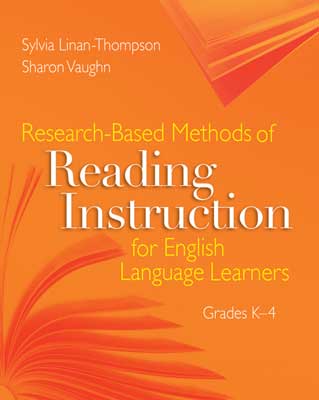
Research-Based Methods of Reading Instruction for English Language Learners, Grades K–4

by Sylvia Linan-Thompson and Sharon Vaughn

Table of Contents


References

Adams, M. J. (1990). Beginning to read: Thinking and learning about print. Cambridge, MA: MIT Press.

Adams, M. J. (2000). Fox in a box. Monterey, CA: CTB McGraw-Hill.

Adams, M. J. (2001). Alphabetic anxiety and explicit, systematic phonics instruction: A cognitive science perspective. In S. B. Neuman & D. K. Dickinson (Eds.), Handbook of early literacy research (pp. 66–80). New York: Guilford Press.

Adams, M. J., Foorman, B. R., Lundberg, I., & Beeler, T. (1998). Phonemic awareness in young children: A classroom curriculum. Baltimore: Paul H. Brookes.

Allington, R. L., & Cunningham, P. M. (2002). Schools that work: Where all children read and write (2nd ed.). Boston: Allyn & Bacon.

Au, K. H. (1993). Literacy instruction in multicultural settings. Orlando, FL: Holt, Rinehart & Winston.

August, D., Carlo, M., Lively, T. J., McLaughlin, B., & Snow, C. (2006). Promoting the vocabulary growth of English learners. In T. A. Young & N. L. Hadaway (Eds.), Supporting the literacy development of English learners (pp. 96–112). Newark, DE: International Reading Association, Inc.

August, D., & Hakuta, K. (Eds.). (1997). Improving schooling for language-minority children: A research agenda. Washington, DC: National Academy Press.

Baker, S. (2003). Enhancing core reading instruction for English language learners in kindergarten and grade 1. Presented at the Institute for Beginning Reading II, Salem, OR.

Baker, S. K., Simmons, D. C., & Kame'enui, E. J. (1998). Vocabulary acquisition: Research bases. In D. C. Simmons & E. J. Kame'enui (Eds.), What reading research tells us about children with diverse learning needs (pp. 183–218). Mahway, NJ: Erlbaum.

Ball, E. W., & Blachman, B. A. (1991). Does phoneme awareness training in kindergarten make a difference in early word recognition and development spelling? Reading Research Quarterly, 26, 49–66.

Bear, D. R., Invernizzi, M., Templeton, S., & Johnston, F. (2008). Words their way: Word study for phonics, vocabulary, and spelling instruction. Upper Saddle River, NJ: Prentice-Hall.

Beck, I. L., McKeown, M. G., & Kucan L. (2002). Bringing words to life: Robust vocabulary instruction. New York: Guilford Press.

Beck, I. L., McKeown, M. G., Sandora, C., & Kucan, L. (1996). Questioning the author: A yearlong classroom implementation to engage students with text. The Elementary School Journal, 96, 385–414.

Behavioral Research & Teaching. (2005, January). Oral reading fluency: 90 years of assessment. (BRT Technical Report No. 33). Eugene, OR: Author.

Bender, W. N., & Larkin, M. J. (2003). Reading strategies for elementary students with learning disabilities. Thousand Oaks, CA: Corwin Press.

Biemiller, A. (1999). Language and reading success. Cambridge, MA: Brookline Books.

Blachman, B. A., Ball, E. W., Black, R., & Tangel, D. M. (2000). Road to the code: A phonological awareness program for young children. Baltimore: Paul H. Brookes.

Black, E. B. (1952). A study of the consonant situations in a primary reading vocabulary. Education, 72(9), 618–623.

Blackowicz, C. L., & Fisher, P. (2002). Teaching vocabulary in all classrooms (2nd ed.). Upper Saddle River, NJ: Pearson.

Blackowicz, C. L., & Ogle, D. (2001). Reading comprehension: Strategies for independent learners. New York: Guilford Press.

Blevins, W. (1998). Phonics from A to Z: A practical guide. New York: Scholastic Professional Books.

Blevins, W. (2001). Building fluency: Lessons and strategies for reading success. New York: Scholastic.

Block, C. C., & Pressley, M. (2003). Best practices in comprehension instruction. In L. M. Morrow, L. B. Gambrell, & M. Pressley (Eds.), Best practices in literacy instruction (2nd ed., pp. 111–126). New York: Guilford Press.

Block, C. C., Rodgers, L. L., & Johnson, R. B. (2004). Comprehension process instruction. New York: Guilford Press.

Bos, C. S. (1987). Promoting story comprehension using a story retelling strategy. Paper presented at the Teachers Applying Whole Language Conference, Tucson, AZ.

Bos, C. S., & Reyes, E. I. (1996). Conversations with a Latina teacher about education for language-minority students with special needs. Elementary School Journal, 96, 343–352.

Bos, C. S., & Vaughn, S. (2006). Strategies for teaching students with learning and behavior problems (6th ed.). Boston: Allyn and Bacon.

Bowers, L., Huisingh, R., LoGiudice, C., Orman, J., & Johnson, P. F. (2000). 125 vocabulary builders. East Moline, IL: LinguiSystems.

Bradley, L., & Bryant, P. E. (1985). Rhyme and reason in reading and spelling. International Academy for Reading in Learning Disabilities, Monograph Series, 1, 75–95. Ann Arbor: University of Michigan Press.

Brown, R., El-Dinary, P. B., Pressley, M., & Coy-Ogan, L. (1995). A transactional strategies approach to reading instruction (National Reading Research Center). The Reading Teacher, 49, 256–258.

Byrne, B. (1998). The foundation of literacy: The child's discovery of the alphabetic principle. Hove, UK: Psychology Press.

Byrne, B., & Fielding-Barnsley, R. (1989). Phonemic awareness and letter knowledge in the child's acquisitions of the alphabetic principle. Journal of Educational Psychology, 81, 313–321.

Calderon, M. (1998). Cooperative learning for bilingual instruction: Manual for teachers and teacher trainers. El Paso, TX: MTTI.

Calderon, M. E., Hertz-Lazarowitz, R., & Slavin, R. (1996). Effects of bilingual cooperative integrated reading and composition on students transitioning from Spanish to English reading. Unpublished paper for the Office of Educational Research and Improvement, U.S. Department of Education, Washington, DC.

Calderon, M. E., & Minaya-Rowe, L. (2003). Designing and implementing two-way bilingual programs: A step-by-step guide for administrators, teachers, and parents. Thousand Oaks, CA: Corwin Press.

Carnine, D. (1999). Perspective: Campaigns for moving research to practice. Remedial and Special Education, 20, 2–9.

Carnine, D. W., Silbert, J., & Kame'enui, E. J. (1997). Direct instruction reading (3rd ed.). Upper Saddle River, NJ: Merrill.

Center for the Improvement of Early Reading Achievement (CIERA). (2001). Put reading first: The research building blocks for teaching children to read. Washington, DC: Partnership for Reading.

Chall, J. S. (2000). The academic achievement challenge: What really works in the classroom? New York: Guilford Press.

Chamot, A., & O'Malley, J. M. (1994). The CALLA handbook. Reading, MA: Addison-Wesley.

Chard, D. J., & Dickson, S. V. (1999). Phonological awareness: Instructional and assessment guidelines. Intervention in School and Clinic, 34, 261–270.

Chard, D. J., & Osborn, J. (1999). Word recognition instruction: Paving the road to successful reading. Intervention in School and Clinic, 34, 271–277.

Chard, D. J., Simmons, D. C., & Kame'enui, E. J. (1998). Word recognition: Research bases. In E. J. Kame'enui & D. C. Simmons (Eds.), What reading research tells us about children with diverse learning needs: Bases and basics (pp. 141–167). Mahwah, NJ: Erlbaum.

Chiappe, P. R., Siegel, L. S., & Wade-Woolley, L. (2002). Linguistic diversity and the development of reading skills: A longitudinal study. Scientific Studies of Reading, 6, 369–400.

Children's Educational Services, Inc. (1987). Test of oral reading fluency. Minneapolis, MN: Author.

Cicero, C. A., & Royer, J. M. (1995). The development of cross-language transfer of phonological awareness. Journal of Contemporary Educational Psychology, 20, 275–303.

Clay, M. (1993). Reading recovery: A guidebook to teachers in training. Portsmouth, NH: Heinemann.

Clay, M. (2002). Three into one will go: Putting Humpty Dumpty together again. Paper presented at the Canadian Regional IRA Conference, Vancouver, BC.

Comeau, L., Cormier, P., Grandmaison, E., & Lacroix, D. (1999). A longitudinal study of phonological processing skills in children learning to read in a second language. Journal of Educational Psychology, 91, 29–43.

Cooper, H. (1996). Speaking power to truth: Reflections of an educational researcher after 4 years of school board service. Educational Researcher, 25, 29–34.

Cunningham, A., & Stanovich, K. E. (1998). What reading does to the mind. American Educator, 22(1–2), 8–15.

Cunningham, P. M. (1998). The multisyllabic word dilemma: Helping students build meaning, spell, and read “big” words. Reading and Writing Quarterly: Overcoming Learning Difficulties, 14, 189–218.

Cunningham, P. M. (1999). Phonics they use: Words for reading and writing (3rd ed.). Boston: Addison-Wesley.

Cunningham, P. M. (2004). Phonics they use: Words for reading and writing (4th ed.). Boston: Allyn and Bacon.

Dale, E. (1965). Vocabulary measurement: Techniques and major findings. Elementary English, 42, 82–88.

Davis, F. B. (1942). Two new measures of reading ability. Journal of Educational Psychology, 33, 365–372.

Denton, C., Anthony, J. L., & Parker, R. (2004). Effects of two tutoring programs on the English reading development of Spanish-English bilingual students. Elementary School Journal, 104, 289–305.

Dianda, M., & Flaherty, J. (1995). Effects of Success for All on the reading achievement of first graders in California bilingual programs. Los Alamitos, CA: Southwest Regional Educational Laboratory.

Diaz-Rico, L. T. (2004). Teaching English learners: Strategies and methods. Boston: Allyn and Bacon.

Dickson, S. V., Simmons, D. C., & Kame'enui, E. J. (1995a). Text organization and its relation to reading comprehension: A synthesis of the research. (Tech. Rep. No. 17). Eugene: University of Oregon, National Center to Improve the Tools of Educators.

Dickson, S. V., Simmons, D. C., & Kame'enui, E. J. (1995b). Text organization: Curricular and instructional implications for diverse learners. (Tech. Rep. No. 18). Eugene: University of Oregon, National Center to Improve the Tools of Educators.

Donat, D. J. (2003). Reading their way: A balance of phonics and whole language. Lanham, MD: Rowman & Littlefield.

Donovan, M. S., & Cross, C. T. (2002). Minorities in special and gifted education. Washington, DC: National Research Council.

Duke, N. K., & Bennett-Armistead, V. S. (2003). Reading and writing informational text in the primary grades: Research-based practices. New York: Scholastic.

Durgunoglu, A. Y., Nagy, W., & Hancin-Bhatt, B. (1993). Cross-language transfer of phonological awareness. Journal of Educational Psychology, 85, 453–465.

Durkin, D. (1978–1979). What classroom observations reveal about reading instruction. Reading Research Quarterly, 14(4), 481–533.

Ebbers, S. M. (2004). Vocabulary through morphemes: Suffixes, prefixes, and roots for intermediate grades. Longmont, CO: Sopris West.

Echevarria, J., Vogt, M., Short, D. J. (2004). Making content comprehensive for English learners: The SIOP model. Pearson: Boston.

Edelsky, C. (1981a). Conversational analysis: New perspectives. In C. Edelsky (Ed.), Conversational analysis: New perspectives, Special issue of the Journal of the Linguistic Association of the Southwest, 4(1).

Edelsky, C. (1981b). Having the floor: Two general ways. In C. Edelsky (Ed.), Conversational analysis: New perspectives, Special issue of the Journal of the Linguistic Association of the Southwest, 4(1), 56–75.

Edelsky, C., Casanova, U., Guzzetti, B., Hudelson, S., Kansy, H., & Y Serna, I. (1993). Lost & found, review of E. Hoffman, “Lost in Translation.” Review of Education, 15, 307–315.

Ehri, L. C. (1991). Learning to read and spell words. In L. Rieben & C. A. Perfetti (Eds.), Learning to read and its implications (pp. 57–73). Hillsdale, NJ: Erlbaum.

Ehri, L. C., Nunes, S. R., Willows, D. M., Schuster, B., Yaghoub-Zadeh, Z., & Shanahan, T. (2001). Phonemic awareness instruction helps children learn to read: Evidence from the National Reading Panel's meta-analysis. Reading Research Quarterly, 36, 250–287.

Fashola, O. S., Drum, P. A., Mayer, R. E., & Kang, S. (1996). A cognitive theory of orthographic translations: Predictable errors in how Spanish-speaking children spell English words. American Educational Research Journal, 33, 825–844.

Fitzgerald, J., & Noblit, G. (2000). Balance in the making: Learning to read in an ethnically diverse first-grade classroom. Journal of Educational Psychology, 92, 3–22.

Foorman, B. R., & Torgesen, J. (2001). Critical elements of classroom and small-group instruction promote reading success in all children. Learning Disabilities Research and Practice, 16, 203–212.

Fuchs, D., Fuchs, L. S., Mathes, P. G., & Simmons, D. C. (1997). Peer-assisted learning strategies: Making classrooms more responsive to diversity. American Educational Research Journal, 34(l), 174–206.

Fuchs, D., Fuchs, L., Thompson, A., Al Otaiba, S., Yen, L., Yang, N., Braun, M., & O'Connor, R. E. (2001). Is reading important in reading-readiness programs? A randomized field trial with teachers as program implementers. Journal of Educational Psychology, 93, 251–267.

Fuchs, L., Fuchs, D., & Hamlett, C. (1989). Monitoring reading growth using student recalls: Effects of two teacher feedback systems. Journal of Educational Research, 83, 101–111.

Fuchs, L. S., Fuchs, D., Hosp, M. K., & Jenkins, J. R. (2001). Oral reading fluency as an indicator of reading competence: A theoretical, empirical, and historical analysis. Scientific Studies of Reading, 5, 239–256.

Fuchs, L. S., Hamlett, C. L., & Fuchs, D. (1997). Monitoring basic skills progress: basic reading (2nd ed.) [Computer software and manual]. Austin, TX: Pro-ED.

Garcia, G. E. (2003). The reading comprehension development and instruction of English-language learners. In A. P. Sweet & C. E. Snow (Eds.), Rethinking reading comprehension (pp. 30–50). New York: Gulliford.

Gersten, R., & Baker, S. (2003). English-language learners with learning disabilities. In H. L. Swanson, K. R. Harris, & S. Graham (Eds.), Handbook of learning disabilities (pp. 94–109). New York: Guilford Press.

Gersten, R., Fuchs, L., Williams, J. P., & Baker, S. (2001). Teaching reading comprehension strategies to students with learning disabilities. Review of Educational Research, 279–320.

Gersten, R., & Geva, E. (2003). Teaching reading to English language learners. Education Leadership, 60(7), 44–49.

Gersten, R. M. & Jimenez, R. T. (1994). A delicate balance: Enhancing literacy instruction for students of English as a second language. The Reading Teacher, 47(6), 438–449.

Geva, E. (2000). Issues in the assessment of reading disabilities in L2 children: Beliefs and research evidence. Dyslexia, 6, 13–28.

Geva, E., Yaghoub-Zadeh, Z., & Schuster, B. (2000). Understanding individual differences in word recognition skills of ESL children. Annals of Dyslexia, 50, 123–154.

Gilbert, J. (2001). The well-read cook's book. Self-published.

Goldenberg, C., & Gallimore, R. (1991). Local knowledge, research knowledge, and educational change: A case study of first-grade Spanish reading improvement. Educational Researcher, 20(8), 2–14.

Goldenberg, C., & Sullivan, J. (1994). Making change happen in a language-minority school: A search for coherence. EPR #13. Washington, DC: Center for Applied Linguistics.

Good, R. H., Kaminski, R. A., Smith, S., Laimon, D., & Dill, S. (2003). Dynamic indicators of basic early literacy skills (6th ed.). Eugene, OR: University of Oregon. Available: http://dibels.uoregon.edu

Goswami, U. (2000). Casual connections in beginning reading: The importance of rhyme. Journal of Research in Reading, 22, 217–240.

Goswami, U. (2006). Neuroscience and education: From research to practice. Nature Reviews Neuroscience, 7, 406–413.

Goswami, U., & Bryant, P. (1990). Phonological skills and learning to read. Mawah, NJ: Erlbaum.

Gottardo, A., Yan, B., Siegel, L. S., & Wade-Woolley, L. (2001). Factors related to English reading performance in children with Chinese as a first language: More evidence of cross-language transfer of phonological processing. Journal of Educational Psychology, 93, 530–542.

Gough, P., & Tumner, W. (1986). Decoding, reading, and reading disability. Remedial and Special Education, 7, 6–10.

Grabe, W. (1991). Current developments in second language reading research. TESOL Quarterly, 25, 375–406.

Graves, A. W. (1986). Effects of direct instruction and metacomprehension training on finding main ideas. Learning Disabilities Research and Practice, 1, 90–100.

Graves, A., Gersten, R., & Haager, D. (2004). Literacy instruction in multiple-language first-grade classrooms: Linking student outcomes to observed instructional practice. Learning Disabilities Research and Practice, 19, 262–272.

Graves, M. F., Juel, C., & Graves, B. B. (1998). Teaching reading in the 21st century. Needham Heights, MA: Allyn and Bacon.

Graves, M. F., Juel, C., & Graves, B. B. (2001). Teaching reading in the 21st century (2nd ed.). Boston: Allyn and Bacon.

Graves, M. F., Prenn, M., & Cooke, C. L. (1985). The coming attractions: Previewing short stories. Journal of Reading, 28, 594–598.

Graves, M. F., & Slater, W. H. (1996). Vocabulary instruction in content areas. In D. Lapp, J., Flood, & N. Farnan (Eds.), Content area reading and learning. Needham Heights, MA: Allyn and Bacon.

Greaney, K. T., Tunmer, W. E., & Chapman, J. W. (1997). Effects of rime-based orthographic analogy training on the word recognition of children with reading disability. Journal of Educational Psychology, 89, 645–651.

Gunn, B., Biglan, A., Smolkowski, K., & Ary, D. (2000). The efficacy of supplemental instruction in decoding skills for Hispanic and non-Hispanic students in early elementary school. The Journal of Special Education, 34(2), 90–103.

Gunn, B., Smolkowski, K., Biglan, A., Black, C., & Blair, J. (2005). Fostering the development of reading skill through supplemental instruction: Results for Hispanic and non-Hispanic students. The Journal of Special Education, 39(2), 66–85.

Haager, D., Gersten, R., Baker, S., & Graves, A. (2003). The English-language learner classroom observation instrument: Observations of beginning reading instruction in urban schools. In S. R. Vaughn & K. L. Briggs (Eds.), Reading in the classroom: Systems for observing teaching and learning (pp. 111–114). Baltimore: Paul H. Brookes.

Haley, M. H., & Austin, T. Y. (2004). Content-based second language teaching and learning: An interactive approach. Boston: Pearson/Allyn and Bacon.

Hart, B., & Risley, T. R. (2003). The early catastrophe. Washington, DC: American Federation of Teachers.

Hasbrouck, J. E., & Tindal, G. (1992). Curriculum-based oral reading fluency norms for students in grades 2 through 4. Teaching Exceptional Children, 24, 41–44.

Haver, J. J. (2003). Structured English immersion. Thousand Oaks, CA: Corwin Press.

Hayes, D. P., & Ahrens, M. G. (1988). Vocabulary simplifications for children: A special case of “motherese”? Journal of Child Language, 15, 395–410.

Henry, M. (1997). The decoding /spelling curriculum: Integrated decoding and spelling instruction from pre-school to early secondary school. Dyslexia, 3, 178–189.

Henry, M. K. (2003). Unlocking literacy: Effective decoding and spelling instruction. Baltimore: Paul H. Brookes.

Hernandez, H. (1997). Teaching in multicultural classrooms. Upper Saddle River, NJ: Merrill/Prentice-Hall.

Hernandez, J. S. (1991). Assisted performance in reading comprehension strategies with non-English proficient students. The Journal of Educational Issues of Language Minority Students, 8, 91–112.

Herrell, A., & Jordan, M. (2004). Fifty strategies for teaching English language learners (2nd ed.). Upper Saddle River, NJ: Pearson.

Hickman, P., Pollard-Durodola, S., & Vaughn, S. (2004). Storybook reading: Improving vocabulary and comprehension for English language learners. The Reading Teacher, 57(8), 720–730.

Hiebert, E. H. (2002). QuickReads: A research-based fluency program. Parsippany, NJ: Modern Curriculum Press.

Hiebert, E. H., & Sawyer, C. C. (1984). Young children's concurrent abilities in reading and spelling. Paper presented at the annual meeting of the American Educational Research Association, New Orleans, LA.

Honig, B. (1999). Reading the right way. In Reading research: Anthology The why? of reading instruction (pp. 7–12). Novato, CA: Arena Press (Consortium on Reading Excellence [CORE]).

Honig, B., Diamond, L., & Gutlohn, L. (2000). CORE teaching reading. Novato, CA: Arena Press.

Hudelson, S. (1984). Kan yu ret an rayt en ingles: Children become literate in English as a second language. TESOL Quarterly, 18, 221–238.

Hudson, R. F., & Smith, S. W. (2001). Effective reading instruction for struggling Spanish-speaking readers: A combination of two literatures. Intervention in School and Clinic, 37(1), 36–39.

Institute for Education Sciences. (2005). National Assessment of Educational Progress (NAEP) 2004 trends in academic progress. Three decades of student performance in reading and mathematics: Findings in brief. National Center on Educational Statistics, U.S. Department of Education.

Invernizzi, M., & Meier, J. (2002). Phonological awareness literacy screening (PALS 1–3). Charlottesville: University of Virginia Press.

Jenkins, J. R., Heliotis, J., Stein, M. L., & Haynes, M. (1987). Improving reading comprehension by using paragraph restatements. Exceptional Children, 54, 54–59.

Jitendra, A. K. (1998). Effects of a direct instruction mail idea summarization program and self-monitoring on reading comprehension of middle school students with learning disabilities. Reading and Writing Quarterly: Overcoming Learning Disabilities, 14, 379–396.

Jitendra, A. K., Hoppes, M. K., & Xin, Y. P. (2000). Enhancing main idea comprehension for students with learning problems: The role of a summarization strategy and self-monitoring instruction. Journal of Special Education, 34(3), 127–139.

Juel, C. (1988). Learning to read and write: A longitudinal study of 54 children from first through fourth grades. Journal of Educational Psychology, 80(4), 437–447.

Kame'enui, E. J., & Simmons, D. C. (2001). Introduction to this special issue: The DNA of reading fluency. Scientific Studies of Reading, 5, 203–210.

Kamil, M. L. (2004). Vocabulary and comprehension instruction: Summary and implications of National Reading Panel findings. In P. McCardle & V. Chhabra (Eds.), The voice of evidence in reading research (pp. 213–234). Baltimore: Paul H. Brookes.

Kaminski, R. R., & Good, R. (1996). Toward a technology for assessing basic early literacy skills. School Psychology Review, 25, 215–227.

Klingner, J. K., Vaughn, S., Dimino, J., Schumm, J. S., & Bryant, D. P. (2001). From clunk to click: Collaborative strategic reading. Longmont, CO: Sopris West.

Koskinen, P. S., Blum, I. H., Bisson, S. A., Phillips, S. M., Creamer, T. S., & Baker, T. K. (1999). Shared reading, books, and audiotapes: Supporting diverse students in school and home. The Reading Teacher, 52(5), 430–444.

Kress, J. (1993). The ESL book of lists. Upper Saddle River, NJ: Prentice-Hall.

Kreuger, E., & Townshend, N. 1997. Reading clubs boost second-language first graders' reading achievement. The Reading Teacher, 51, 122–127.

Kuhn, M. R., & Stahl, S. A. (2003). Fluency: A review of development and remedial practices. Journal of Educational Psychology, 95, 3–21.

Learning First Alliance. (2000). Every child reading: A professional development guide. Washington, DC.

Lee, D. M., & Allen, R. C. (1963). Learning to read through experience (2nd ed.). New York: Meredith.

Lenters, K. (2004). No half-measures: Reading instruction for young second-language learners. The Reading Teacher, 58(4), 328–336.

Lenters, K. (2005). What reading teachers should know about ESL learners. The Reading Teacher, 57, 22–30.

Leslie, L., & Caldwell, J. (2001). The qualitative reading inventory 3. New York: Addison-Wesley Longman.

Linan-Thompson, S., & Hickman-Davis, P. (2002). Supplemental reading instruction for students at risk for reading disabilities: Improve reading thirty minutes at a time. Learning Disabilities Research and Practice, 17, 241–250.

Linan-Thompson, S., Vaughn, S., Hickman-Davis, P., & Kouzekanani, K. (2003). Effectiveness of supplemental reading instruction for second-grade English language learners with reading difficulties. The Elementary School Journal, 103, 221–238.

Lindsey, K., Manis, F., & Bailey, C. (2003). Prediction of first-grade reading in Spanish-speaking English-language learners. Journal of Educational Psychology, 95, 482–494.

Lundberg, I., Frost, J., & Peterson, O. (1998). Effects of an extensive program for stimulating phonological awareness in preschool children. Reading Research Quarterly, 23, 263–284.

Lundberg, I., Olofsson, A., & Wall, S. (1980). Reading and spelling skills in the first school years predicted from phonemic awareness skills in kindergarten. Scandinavian Journal of Psychology, 21, 159–173.

MacGinitie, W. H., MacGinitie, R. K., Maria, K., Dreyer, L. G., & Hughes, K. E. (2000). Gates-MacGinitie Reading Tests, fourth edition (GRMT-4). Itasca, IL: Riverside.

Malone, L. D., & Mastropieri, M. (1992). Reading comprehension instruction: Summarization and self-monitoring training for students with learning disabilities. Exceptional Children, 58, 270–279.

Mastropieri, M. A., & Scruggs, T. E. (1997). Best practices in promoting reading comprehension in students with learning disabilities: 1976 to 1996. Remedial and Special Education, 18, 197–214.

McCormick, C. E., Throneburg, R., & Smitley, J. (2002). A sound start: Phonemic awareness lessons for reading success. New York: Guilford Press.

McKenna, M. C., & Stahl, S. A. (2003). Assessment for reading instruction. New York: Guilford Press.

McLaughlin, B. (1987). Theories of second-language learning. London: Edward Arnold.

Moats, L. (2000). Speech to print: Language essentials for teachers. Baltimore: Paul H. Brookes.

Moats, L. (2001). When older students can't read. Educational Leadership, 58(6), 36–40.

Muniz-Swicegood, M. (1994). The effects of metacognitive reading strategy training on the reading performance and student reading analysis strategies of third-grade bilingual students. Bilingual Research Journal, 18, 83–97.

Nagy, W. E., & Anderson, R. C. (1984). How many words are there in printed school English? Reading Research Quarterly, 19, 304–330.

Nagy, W. E., Garcia, G. E., Durgunoglu, A., & Hancin-Bhatt, B. (1993). Spanish-English bilingual children's use and recognition of cognates in English reading. Journal of Reading Behavior, 25, 241–259.

National Reading Panel (NRP). (2000). Teaching children to read: An evidence-based assessment of the scientific research literature on reading and its implications for reading instruction. Reports of the subgroups. (NIH Publication No. 00-4754). Bethesda, MD: National Institutes of Health, National Institute of Child Health and Human Development.

National Research Council (NRC). (1998). Preventing reading difficulties in young children. Washington, DC: National Academy Press.

Newcomer, P. (1999). Standardized reading inventory, second edition (SRI-2). Austin, TX: Pro-Ed.

No Child Left Behind Act of 2001. Public Law 107-110. (2001, August 2). Pub. L. No. 107-110, (H. R. 1). Retrieved from www.nochildleftbehind.gov

Oaks, R. E. (1952). A study of the vowel situations in a primary reading vocabulary. Education.

O'Connor, R. E. (2000). Increasing the intensity of intervention in kindergarten and first grade. Learning Disabilities Research and Practice, 15, 43–54.

O'Connor, R. E., Notari-Syverson, A., & Vadasy, P. F. (2005). Ladders to literacy. Baltimore: Paul H. Brookes.

Ogle, D. M. (1986). KWL: A teaching model that develops active reading of expository text. The Reading Teacher, 39, 564–570.

O'Shea, L. J., Sindelar, P. T., & O'Shea, D. J. (1987). The effects of repeated readings and attentional cues on the reading fluency and comprehension of learning disabled readers. Learning Disabilities Research, 2, 103–109.

Perfetti, C. A. (1977). Language comprehension and fast decoding: Some psycholinguistic prerequisites for skilled reading comprehension. In J. T. Guthrie (Ed.), Cognition, curriculum, and comprehension (pp. 20–41). Newark, DE: International Reading Association.

Perfetti, C. A. (1985). Reading ability. New York: Oxford University Press.

Pressley, M. (1998; 2006). Reading instruction that works: The case for balanced teaching. New York: Guilford Press.

Pressley, M., & Afflerbach, P. (1995). Verbal protocols of reading: The nature of constructively responsive reading. Mahwah, NJ: Erlbaum.

Pressley, M., & El-Dinary, P. B. (1997). What we know about translating comprehension-strategies instruction research into practice. Journal of Learning Disabilities, 30, 486–488, 512.

Quiroga, T., Lemos-Britton, Z., Mostafapour, E., & Berninger, V. (2002). Phonological awareness and beginning reading in Spanish-speaking ESL first graders: Research into practice. Journal of School Psychology, 40, 85–111.

Rabren, K., Darch, C., & Eaves, R. C. (1999). The differential effects of two systematic reading comprehension approaches with students with learning disabilities. Journal of Learning Disabilities, 32(1), 36–47.

RAND Reading Study Group. (2002). Reading for understanding: Toward an R&D program in reading comprehension. Santa Monica, CA: RAND Corporation.

Rasinski, T. V. (2003). The fluent reader: Oral reading strategies for building word recognition, fluency, and comprehension. New York: Scholastic Professional Books.

Reid, D. K., Hresko, W. P., & Hammill, D. D. (2001). Test of early reading ability, third edition (TERA-3). Austin, TX: Pro-Ed.

Reutzel, D. R., & Cooter, R. B., Jr. (1999). Balanced reading strategies and practices: Assessing and assisting readers with special needs. Upper Saddle River, NJ: Merrill.

Saunders, W., O'Brien, G., Lennon, D., & McLean, J. (1996). Making the transition to English literacy successful: Effective strategies for studying literature with transition students. In R. Gersten & R. Jimenez (Eds.), Effective strategies for teaching language minority students. Monterey, CA: Brooks Cole.

Schumm, J. S., Moody, S. W., & Vaughn, S. R. (2000). Grouping for reading instruction: Does one size fit all? Journal of Learning Disabilities, 33, 477–488.

Scott, J. A., & Nagy, W. E. (2004). Developing word consciousness. In J. F. Baumann & E. J. Kame'enui (Eds.), Vocabulary instruction: Research to practice (pp. 201–217). New York: Guilford Press.

Seymour, P. H. K. (2006). Framework for beginning reading in different orthographies. In R. Malatesha Joshi & P. G. Aaron (Eds.), Handbook of orthography and literacy. Mahway, NJ: Erlbaum.

Share, D. L. (1995). Phonological recoding and self-teaching: Sine qua non of reading acquisition. Cognition, 55, 155–218.

Shaywitz, S. E., & Shaywitz, B. A. (1996). Unlocking learning disabilities: The neurological basis. In S. C. Cramer & W. Ellis (Eds.), Learning disabilities: Lifelong issues (pp. 255–260). Baltimore: Paul H. Brookes.

Short, D., & Echevarria, J. (2005). Teacher skills to support English language learners. Educational Leadership, 62, 8–13

Sindelar, P. T., Monda, L. E., & O'Shea, L. J. (1990). The effects of repeated readings on instructional and mastery level readers. Journal of Educational Research, 83, 220–226.

Smith, M. K. (1941). Measurement of the size of general English vocabulary through the elementary grades and high school. Genetic Psychological Monograph, 24, 311–345.

Smith, S. B., Simmons, D. C., & Kame'enui, E. J. (1998). Phonological awareness: Research bases. In D. C. Simmons & E. J. Kame'enui (Eds.), What reading research tells us about children with diverse learning needs: Bases and basics. Mahwah, NJ: Erlbaum.

Snow, C. E., Burns, M. S., & Griffin, P. (Eds.). (1998). Preventing reading difficulties in young children. Washington, DC: National Academy Press.

Stahl, S. A. (1985). To teach a word well: A framework for vocabulary instruction. Reading World, 24(3), 16–27.

Stahl, S. A. (1986). Three principles of effective vocabulary instruction. Journal of Reading, 29, 662–668.

Stahl, S. A. (2001). Teaching phonics and phonological awareness. In S. B. Neuman & D. K. Dickinson (Eds.), Handbook of early literacy research (pp. 333–347). New York: Guilford Press.

Stahl, S. A. (2004). What do we know about fluency? Findings of the National Reading Panel. In P. McCardle & V. Chhabra (Eds.), The voice of evidence in reading research (pp. 187–211). Baltimore: Paul H. Brookes.

Stahl, S. A., & Kapinus, B. (2001). Word power: What every educator needs to know about teaching vocabulary. Washington, DC: National Education Association.

Stahl, S. A., & Kuhn, M. R. (2002). Making it sound like language: Developing fluency. The Reading Teacher, 55, 582–584.

Stanovich, K. E. (1986). Matthew effects in reading: Some consequences of individual differences in the acquisition of literacy. Reading Research Quarterly, 21, 360–406.

Stanovich, K. E. (2000). Progress in understanding reading: Scientific foundations and new frontiers. New York: Guilford Press.

Swanson, H. L. (1999). Instructional components that predict treatment outcomes for students with LD: Support for a combined strategy and direct instruction model. Learning Disabilities Research and Practice, 14, 129–140.

Texas Education Agency (TEA). (2000). Guidelines for examining phonics and word recognition programs. Austin, TX: Author.

Tikunoff, W. J. (1983). Compatibility of the SBIF features with other research instruction of LEP students. San Francisco: Far West Laboratory.

Torgesen, J. K. (2000). Individual differences in response to early interventions in reading: The lingering problem of treatment resisters. Learning Disabilities Research and Practice, 15, 55–64.

Torgesen, J. K., & Mathes, P. G. (2000). A basic guide to understanding, assessing, and teaching phonological awareness. Austin, TX: Pro-Ed.

Torgesen, J., Wagner, R., & Rashotte, C. (1994). Longitudinal studies of phonological processing and reading. Journal of Learning Disabilities, 27, 276–286.

Ulanoff, S. H., & Pucci, S. L. (1999). Learning words from books: The effects of reading aloud on second language acquisition. Bilingual Research Journal, 23, 409–422.

University of Texas Center for Reading and Language Arts. (2001a). Essential reading strategies for the struggling reader: Activities for an accelerated reading program. Expanded edition. Austin, TX: Texas Education Agency.

University of Texas Center for Reading and Language Arts. (2001b). Second grade teacher academy. Austin, TX: Texas Education Agency.

University of Texas Center for Reading and Language Arts. (2001c). Supplemental instruction for third grade struggling readers: A guide for tutors. Austin, TX: Texas Education Agency.

University of Texas Center for Reading and Language Arts. (2002a). Reading strategies and activities: A resource book for students at risk for reading difficulties, including dyslexia. Austin, TX: Texas Education Agency.

University of Texas Center for Reading and Language Arts. (2002b). Effective fluency instruction and progress monitoring. Austin, TX: Texas Education Agency.

University of Texas Center for Reading and Language Arts. (2002c). The secretary's reading leadership academy: Effective reading instruction. Austin, TX: Author.

University of Texas Center for Reading and Language Arts. (2003). Effective instruction for elementary struggling readers: Research-based practices (Rev. ed.). Austin, TX: Texas Education Agency.

University of Texas Systems and Texas Education Agency. (2005a). Introduction to the 3-tier reading model: Reducing reading difficulties for kindergarten through third grade students (4th ed.). Austin, TX: Texas Education Agency.

University of Texas System and Texas Education Agency. (2005b). Texas primary reading inventory 2005. Austin, TX: Texas Education Agency.

Vaughn, S., & Dammann, J. E. (2001). Science and sanity in special education. Behavioral Disorders, 27, 21–29.

Vaughn, S., & Linan-Thompson, S. (2004). Research-based methods of reading instruction: Grades K–3. Alexandria, VA: Association for Supervision and Curriculum Development.

Vaughn, S., Linan-Thompson, S., & Hickman, P. (2003). Response to intervention as a means of identifying students with reading/learning disabilities. Exceptional Children, 69, 391–410.

Vaughn, S., Mathes, P. G., Linan-Thompson, S., Cirino, P. T., Carlson, C. D., Pollard-Durodola, S. D., et al. (2006). First-grade English language learners at-risk for reading problems: Effectiveness of an English intervention. Elementary School Journal, 107(2), 153–180.

Vaughn, S., Mathes, P. G., Linan-Thompson, S., & Francis, D. J. (2005). Teaching English language learners at risk for reading disabilities to read: Putting research into practice. Learning Disabilities Research & Practice, 20(1), 58–67.

Vaughn, S., Moody, S., & Schumm, J. S. (1998). Broken promises: Reading instruction in the resource room. Exceptional Children, 64, 211–226.

Wagner, R. K., Torgesen, J. K., & Rashotte, C. A. (1994). Development of reading-related phonological processing abilities: New evidence of bidirectional causality from a latent variable longitudinal study. Developmental Psychology, 30, 73–87.

Walberg, H. J. (1998). Foreword. In K. Topping & S. Ehly, Peer-assisted learning. Mahwah, NJ: Erlbaum.

White, T. G., Sowell, J., & Yanagihara, A. (1989). Teaching elementary students to use word-part clues. The Reading Teacher, 42, 302–308.

Wiederholt, J. L., & Blalock, G. (2000). Gray silent reading tests. Austin, TX: Pro-Ed.

Wiederholt, J. L., & Bryant, B. R. (2001). The Gray oral reading tests, fourth edition (GORT-4). Austin, TX: Pro-Ed.

Wilhelm, J. D. (2001). Improving comprehension with think-aloud strategies. New York: Scholastic.

Williams, J. P. (1988). Identifying main ideas: A basic aspect of reading comprehension. Topics in Language Disorders, 8, 1–13.

Williams, J. P. (1998). Improving the comprehension of disabled readers. Annals of Dyslexia, 48, 213–238.

Wong, B. Y. L., & Jones, W. (1982). Increasing metacomprehension in learning disabled and normally achieving students through self-questing training. Learning Disability Quarterly, 5, 228–240.

Woodcock, R. W. (1998). The WJ-R and Bacteria-R in neuropsychological assessment: Research report number 1. Itasca, IL: Riverside.

Yopp, H. K. (1995). A test for assessing phonemic awareness in young children. The Reading Teacher, 49, 20–29.

Zehr, M. A. (2005). Bilingual educators ratchet up criticism of federal NCLB [No Child Left Behind] law. Education Week, 25(14), 30.


Table of Contents


Copyright © 2007 by Association for Supervision and Curriculum Development. All rights reserved. No part of this publication—including the drawings, graphs, illustrations, or chapters, except for brief quotations in critical reviews or articles—may be reproduced or transmitted in any form or by any means, electronic or mechanical, including photocopy, recording, or any information storage and retrieval system, without permission from ASCD.

MEMBER SIGN IN
Username or Customer ID
Password