

Countdown to Annual Conference
San Antonio, Tex.
March 6-8, 2010
Home
MISSION: ASCD (formerly the Association for Supervision and Curriculum Development) is a membership organization that develops programs, products, and services essential to the way educators learn, teach, and lead.
We are here to help!
1703 North Beauregard St.
Alexandria, VA 22311-1714

Tel: 1-800-933-ASCD (2723)
Fax: 1-703-575-5400

8:00 a.m. to 6:00 p.m. EST Monday through Friday

Local to the D.C. area:
703-578-9600, press 1

Toll-free from the U.S. and Canada: 1-800-933-ASCD (2723), press 1

All other countries (International Access Code): +1-703-578-9600, press 1
Permissions and Translations
ASCD recognizes and respects intellectual property rights and adheres to copyright law. Learn about our rights and permissions policies.


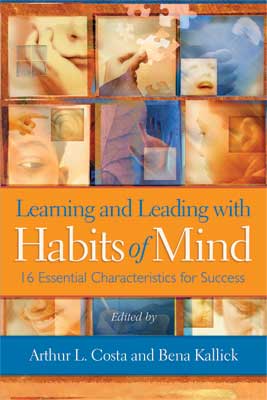
Learning and Leading with Habits of Mind

Edited by Arthur L. Costa and Bena Kallick

Table of Contents


Preface

by Arthur L. Costa and Bena Kallick

Donna Norton Swindal, a resource teacher in Burnsville, Minnesota, shared an interesting story about a 4th grader who brought a newspaper clipping to class. The article described genocide in a troubled African country. After a lively discussion about what was happening there, one concerned classmate stated, "If those people would just learn to persist, they could solve their problems."

His philosophical colleague added, "If they would learn to listen with understanding and empathy, they wouldn't have this problem."

Yet another young activist suggested, "We need to go over there and teach them the Habits of Mind!"

What are the "Habits of Mind" these concerned young citizens were so eager to share? They are the overarching theme of Leading and Learning with Habits of Mind, and they are the heart of the book you hold in your hands.

The Beginning

The idea for the Habits of Mind started in 1982. In our beginning conversations, we referred to them as "intelligent behaviors." In our daily work with students and staff, these ideas flourished into rich experiences. We soon realized that these concepts and experiences needed to be documented and disseminated to others. We discovered that we needed a common terminology for the behaviors that would be expected from one another if, indeed, we were living in a productive learning organization. In 1999 we became entranced with Lauren Resnick's statement (1999) that "one's intelligence is the sum of one's habits of mind." That's it, we thought! We don't want behaviors; we want habits. Learning the behaviors of problem solving, for example, is not the goal. We want to habituate effective problem solving. Performing a behavior once is not enough. We want students to appreciate the value of and to develop the propensity for skillful problem solving using a repertoire of mindful strategies applied in a variety of settings. So we came to call these dispositions Habits of Mind, indicating that the behaviors require a discipline of the mind that is practiced so it becomes a habitual way of working toward more thoughtful, intelligent action.

In 2000 we created a developmental series of four books, published by the Association for Supervision and Curriculum Development, to inspire the work of others. They were

  • Book 1: Discovering and Exploring Habits of Mind
  • Book 2: Activating and Engaging Habits of Mind
  • Book 3: Assessing and Reporting on Habits of Mind
  • Book 4: Integrating and Sustaining Habits of Mind

The intent of Habits of Mind: A Developmental Series was to help educators teach toward these Habits of Mind, which we see as broad, enduring, and essential lifespan learnings that are as appropriate for adults as they are for students. Our hope was that by teaching students (and adults) the Habits of Mind, students would be more disposed to draw upon the habits when they face uncertain or challenging situations. And, ultimately, we hoped the habits would help educators develop thoughtful, compassionate, and cooperative human beings who can live productively in an increasingly chaotic, complex, and information-rich world (as the 4th graders in the anecdote at the start of this preface so aptly demonstrate).

That was 10 years ago. Since that time the Habits of Mind have been embraced by school faculties around the world. The word is spreading to universities, businesses, parents, and other community members. Research has been conducted to demonstrate the positive impact of the Habits of Mind on students, individuals, and entire school staffs. We have been amazed and delighted with the innovations, elaborations, and applications that have sparked teachers, parents, and school leaders to create children's stories, poetry, limericks, songs, school plays, videos, and performances extolling the virtues of the Habits of Mind.

We continue to expand our work through a process we call "a spiral of reciprocal learning." The work that we write about is translated into classroom reality. The realities of the classroom, in turn, inform our writing. Although we occasionally work alongside teachers in their classrooms, we more often work alongside the work that they send to us. As we study their work, we develop an enhanced theory of learning about the habits. The Habits of Mind have influenced not only school practices but also the entire culture of schools. (The stories from Friendship Valley Elementary School, Waikiki School, Furr High School, and Tahoma School District presented in Chapters 19 through 22 are examples.) We need to continue to tell the classroom stories, as they help to crystallize a theory of practice with the Habits of Mind. This book, Learning and Leading with Habits of Mind, is intended to serve that purpose.

A Dual Purpose

The most powerful learning communities use these Habits of Mind to guide all their work. Yet sometimes the practicality of school life requires that people make individual commitments with the hope that their beliefs and behaviors will affect the whole. Teaching with the Habits of Mind requires a shift toward a broader conception of educational outcomes and how they are cultivated, assessed, and communicated. Learning and Leading with Habits of Mind aims to help you work toward and achieve a move from "individual" to "systems" in your thinking.

In this book, we provide the following:

  • Descriptions and examples of the Habits of Mind.
  • Instructional strategies intended to foster acquisition of these habits at school and at home.
  • Assessment tools that provide a way to gather evidence of student growth in the Habits of Mind.
  • Suggestions for ways to involve students, teachers, and parents in communicating progress toward acquiring the Habits of Mind.
  • Descriptions from schools, teachers, and administrators about how they have incorporated the Habits of Mind into their practice.
  • Examples of the effects that the Habits of Mind have had on students, staffs, individual teachers, and their work, as well as on the culture of the school.
  • Descriptions of qualities of leadership necessary for the Habits of Mind to become successfully infused into school cultures and classrooms.

Our true intent for this book, however, is far more panoramic, pervasive, and long-range. It works at two levels. The first level encompasses immediate and practical considerations that promote using the Habits of Mind in classrooms and schools every day. The second level addresses a larger, more elevated concern for creating a learning culture that considers the Habits of Mind as central to building a thoughtful community and world. We have divided the book into separate sections, each addressing the levels as follows:

Part I: Discovering and Exploring Habits of Mind

  • Level 1: Defining the Habits of Mind and understanding the significance of developing these habits as a part of lifelong learning.
  • Level 2: Encouraging schools and communities to elevate their level and broaden their scope of curricular outcomes by focusing on more essential, enduring life span learnings.

Part II: Building a Thought-Full Environment

  • Level 1: Learning how to teach the habits directly and to reinforce them throughout the curriculum.
  • Level 2: Enhancing instructional decision making to employ content not as an end of instruction but as a vehicle for activating and engaging the mind.

Part III: Assessing and Reporting on Habits of Mind

  • Level 1: Learning about a range of techniques and strategies for gathering evidence of students' growth in and performance of the Habits of Mind.
  • Level 2: Using feedback to guide students to become self-assessing and to help school teams and parents use assessment data to cultivate a more thoughtful culture.

Part IV: Leading Schools with Habits of Mind in Mind

  • Level 1: Learning strategies for extending the impact of the Habits of Mind throughout the school culture and community.
  • Level 2: Forging a common vision among all members of the educational community from kindergarten through postgraduate work: teachers, administrative teams, administrators, librarians, staff developers, teacher educators, school board members, and parents. This vision describes the characteristics of efficacious and creative thinkers and problem solvers.

Part V: Learning from Mindful Schools

  • Level 1: Learning from other schools and agencies about the powerful effects of the Habits of Mind on student learning, staff members, and the culture of the school.
  • Level 2: Becoming intrigued and inspired to pursue and experience the impact of the Habits of Mind as a transformational tool to create professional learning communities.

The Habits of Mind

The following list contains the 16 Habits of Mind. The habits begin with the individual and move out to the entire community. Keep in mind, however, that the list is not complete. As our conversations continue—and as you work with the habits—we are likely to identify other habits that should be added to this list.

Although they are elaborated in Chapter 2, the 16 Habits of Mind we have identified can be described briefly as follows:

  1. Persisting. Stick to it. See a task through to completion, and remain focused.
  2. Managing impulsivity. Take your time. Think before you act. Remain calm, thoughtful, and deliberate.
  3. Listening with understanding and empathy. Seek to understand others. Devote mental energy to another person's thoughts and ideas. Hold your own thoughts in abeyance so you can better perceive another person's point of view and emotions.
  4. Thinking flexibly. Look at a situation another way. Find a way to change perspectives, generate alternatives, and consider options.
  5. Thinking about thinking (metacognition). Know your knowing. Be aware of your own thoughts, strategies, feelings, and actions—and how they affect others.
  6. Striving for accuracy. Check it again. Nurture a desire for exactness, fidelity, craftsmanship, and truth.
  7. Questioning and posing problems. How do you know? Develop a questioning attitude, consider what data are needed, and choose strategies to produce those data. Find problems to solve.
  8. Applying past knowledge to new situations. Use what you learn. Access prior knowledge, transferring that knowledge beyond the situation in which it was learned.
  9. Thinking and communicating with clarity and precision. Be clear. Strive for accurate communication in both written and oral form. Avoid overgeneralizations, distortions, and deletions.
  10. Gathering data through all senses. Use your natural pathways. Gather data through all the sensory paths: gustatory, olfactory, tactile, kinesthetic, auditory, and visual.
  11. Creating, imagining, innovating. Try a different way. Generate novel ideas, and seek fluency and originality.
  12. Responding with wonderment and awe. Let yourself be intrigued by the world's phenomena and beauty. Find what is awesome and mysterious in the world.
  13. Taking responsible risks. Venture out. Live on the edge of your competence.
  14. Finding humor. Laugh a little. Look for the whimsical, incongruous, and unexpected in life. Laugh at yourself when you can.
  15. Thinking interdependently. Work together. Truly work with and learn from others in reciprocal situations.
  16. Remaining open to continuous learning. Learn from experiences. Be proud—and humble enough—to admit you don't know. Resist complacency.

Finding an Internal Compass

In teaching toward the Habits of Mind, we are interested in not only how many answers students know but also how students behave when they don't know an answer. We are interested in observing how students produce knowledge rather than how they merely reproduce it. A critical attribute of intelligent human beings is not only having information but also knowing how to act on it.

By definition, a problem is any stimulus, question, task, phenomenon, or discrepancy, the explanation for which is not immediately known. Intelligent behavior is performed in response to such questions and problems. Thus, we are interested in focusing on student performance under those challenging conditions—dichotomies, dilemmas, paradoxes, polarities, ambiguities, and enigmas—that demand strategic reasoning, insightfulness, perseverance, creativity, and craftsmanship to resolve.

Teaching toward the Habits of Mind is a team effort. Because the acquisition of these habits requires repeated opportunities over a long period, the entire staff must dedicate itself to teaching toward, recognizing, reinforcing, discussing, reflecting on, and assessing them. When students encounter these habits at each grade level in the elementary years and in each classroom throughout the secondary day—and when the habits also are reinforced and modeled at home—they become internalized, generalized, and habituated. They become an "internal compass" to guide and direct us toward more efficacious, empathic, and cooperative actions.

We need to find new ways of assessing and reporting growth in the Habits of Mind. We cannot measure process-oriented outcomes using old-fashioned, product-oriented assessment techniques. Gathering evidence of performance and growth in the Habits of Mind requires "kid watching." As students interact with real-life, day-to-day problems in school, at home, on the playground, alone, and with friends, teaching teams and other adults can collect anecdotes and examples of written and visual expressions that reveal students' increasingly skillful, voluntary, and spontaneous use of these Habits of Mind in diverse situations and circumstances. This work takes time. The habits are never fully mastered, though they do become increasingly apparent over time and with repeated experiences and opportunities to practice and reflect on their performance.

Student Outcomes for the 21st Century

Learning and innovation skills are what separate students who are prepared for increasingly complex life and work environments in the 21st century from those who are not. Students in our schools today live in a technology- and media-driven environment marked by access to an abundance of information, rapid changes in technology tools, and the need to collaborate and make individual contributions as they prepare for both the workplace and participation in democracy. Today's life and work environments require far more than thinking skills and content knowledge.

To be effective in the 21st century, citizens and workers must be able to communicate, to team, to continuously learn, and to function in a visual, data-rich society. The school and community must emphasize the increasing importance of learning to learn in light of the shift to a digital age that values intellectual capital. This vision redefines the purpose of public education. The school's vision must seek to create learners who have the self-confidence, independence, and high-tech proficiencies to continuously learn—meeting challenges innovatively and creatively (Partnership for 21st Century Skills, 2007).

According to the vision, students need to be prepared with the following skills:

  • Creativity and innovation.
  • Critical thinking and problem solving.
  • Communication and collaboration.
  • Flexibility and adaptability.
  • Initiative and self-direction.
  • Social and cross-cultural skills.
  • Productivity and accountability.
  • Leadership and responsibility.

Leading and Learning with Habits of Mind can help you start down a path to that vision. It provides a road map for individuals, for classrooms, and ultimately for a full-system approach to enhanced curriculum, instruction, and assessment. For our purposes, we think a "system" is approached when the Habits of Mind are integrated throughout the culture of the organization—that is, when all individual members of a learning community share a common vision of the attributes of effective and creative problem solvers not only for their students but for themselves as well; when resources are allocated to the development of those dispositions; when strategies to enhance those characteristics in themselves and others are planned; and when members of the organization join in efforts to continuously assess, refine, and integrate those behaviors in their own and the organization's practices. The result of a full-system approach is exemplified by this excerpt from a 5th grader's valedictorian address during graduation from Friendship Valley Elementary School in Westminster, Maryland:

I can tell you right now that we will never be able to forget the Habits of Mind. They helped us so much! They taught us better ways of doing things and how to resolve problems! We learned respect and manners. My mother was so very impressed with this teaching. Also we learned that you need to get along with others and not to disrespect them either.

Partnership for 21st Century Skills. (2007). Framework for 21st century learning. Tucson, AZ: Author. Available: www.21stcenturyskills.org.

Resnick, L. (1999, June 16). Making America smarter. Education Week, pp. 38–40.


Table of Contents


Copyright © 2008 by Association for Supervision and Curriculum Development. All rights reserved. No part of this publication—including the drawings, graphs, illustrations, or chapters, except for brief quotations in critical reviews or articles—may be reproduced or transmitted in any form or by any means, electronic or mechanical, including photocopy, recording, or any information storage and retrieval system, without permission from ASCD.

MEMBER SIGN IN
Username or Customer ID
Password