

Conference Countdown
Washington, D.C.
June 28-30, 2013
  • membership
  • my account
  • help

    We are here to help!

    1703 North Beauregard Street
    Alexandria, VA 22311-1714
    Tel: 1-800-933-ASCD (2723)
    Fax: 703-575-5400

    8:00 a.m. to 6:00 p.m. Eastern time, Monday through Friday

    Local to the D.C. area, 703-578-9600, press 2

    Toll-free from U.S. and Canada, 1-800-933-ASCD (2723), press 2

    All other countries (International Access Code) + 1-703-578-9600, press 2

  • Log In
  • Forgot Password?


Washington, D.C.

Conference on Teaching Excellence

June 28–30
National Harbor, Md
.

Get up-to-date on recent revelations about best practices in the classroom, how to make them routine in every grade and subject, and how to scale them systemwide. 

Permissions

ASCD respects intellectual property rights and adheres to the laws governing them. Learn more about our permissions policy and submit your request online.

Policies and Requests

Translations Rights

Books in Translation

Sale Book (May 2012)
Related Topics

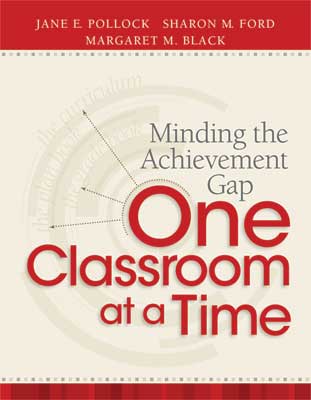
Minding the Achievement Gap One Classroom at a Time

by Jane E. Pollock, Sharon M. Ford and Margaret M. Black

Table of Contents

An ASCD 2012 Study Guide for Minding the Achievement Gap One Classroom at a Time

by Jane E. Pollock, Sharon M. Ford, and Margaret M. Black

This ASCD Study Guide is meant to enhance your understanding of the concepts and practical ideas presented in Minding the Achievement Gap One Classroom at a Time, an ASCD book written by Jane E. Pollock, Sharon M. Ford, and Margaret M. Black. You can use the study guide after you read the book or as you finish each chapter. The questions provided are designed to help you make connections between the text and your professional situations and experiences. Although you may think about these questions on your own, you might consider pairing with a colleague or forming a study group with others who have read (or are reading) Minding the Achievement Gap One Classroom at a Time.

Chapter 1: Minding the Achievement Gap

  1. Historically, rhetoric about schools in crisis parallels social concerns of the time (e.g., perceived deficits in math and science instruction at the beginning of "the space race"; worries about too little emphasis on thinking skills when the information age began its exponential expansion). Today's public rhetoric includes a strong focus on student achievement gaps. As an educator working within the system and aware of the history of such rhetoric, at what "crisis level" would you place achievement gap concerns? Provide a rationale for your response.
  2. Think about the discussions of "schools in crisis" that you have read about or seen in the news. What are the dangers of presenting schools as a solution to an economic challenge?
  3. State and local directives admonishing schools and districts to close achievement gaps often require costly measures, which are implemented to uneven success. Do you agree with the authors' assertion that teachers' intentional instructional changes on a classroom-by-classroom basis ("minding" gaps) is a wise and reliable approach to improving the learning outcomes of vulnerable student populations? Why or why not?
  4. Think about the current building-level initiatives underway in your school or district aimed at closing achievement gaps. What aspects of the initiatives are effectively designed, and which would you refocus if you could do so? How would your "refocused" initiatives differ from the ones now in place? What priorities would guide your changes?
  5. Think of the new instructional techniques you and your colleagues have implemented over the past few years. Which would you designate as "keepers"—those that have a clear, positive, and lasting effect on student learning? Which, by contrast, would you identify as "bandwagon" initiatives? What patterns do you see distinguishing the effective approaches from the ineffective ones?
  6. Jill Cullis's story is one about a teacher realizing her own power to make a difference in her students' learning without a top-down mandate. If you could ask Jill three questions about how she changed her practice to embrace "minding the gap," what would you ask?

Chapter 2: Solutions That Are Invisible in Plain Sight

  1. Positive deviance is a practice of using unconventional methods to succeed in the face of challenging situations. Consider students and teachers in your school, and identify those who are positive deviants. What approaches do you see these individuals implementing in order to succeed?
  2. This chapter stresses the importance of students seeking feedback, covers types of feedback and their sources, and discusses the effectiveness of feedback when it is tied to standards. With this information in mind, how might you alter your classroom practices to provide more opportunities for feedback, a cornerstone of academic learning?
  3. Select a lesson you have recently taught and map that lesson to the GANAG schema. What connections can you make between the presence or absence of GANAG stages and high-yield strategies and the lesson's effectiveness?
  4. Consider the kinds of high-yield strategies that you incorporate into your instruction on a regular basis. How well do your students use these strategies as learning tools? Would they benefit from more explicit instruction on how to use these strategies? How might you provide this instruction?
  5. Each of us grew up observing the "teaching part" of teaching as students in a classroom, but we did not have the same exposure to grading and assessment practices. What is the basis for your own approach to grading and assessment? How would you define effective and ineffective grading and assessment, and how have you adjusted your practices over the years to make your approach more effective?
  6. What steps could you take to strengthen the alignment of your curriculum document, your plan book, and your grade book?

Chapter 3: Students at Risk: Increasing Engagement Through Intentional Teaching

  1. This chapter suggests interactive notebooks as way to encourage students to take more ownership of class notes and assignments and to self-monitor their progress toward goals. What strategies and guidelines for notebook organization and usage do you currently provide for your students? How are your students' notebooks similar to and different from the IN9s—interactive notebooks that incorporate the nine high-yield strategies—discussed in this chapter?
  2. Think about how the IN9 approach would work for the students you teach. What kinds of personalization and special pages would be most effective for your students, given their grade level and the subject area? What are some ways you might ensure that their daily notebook work involves the use of high-yield strategies? What notebook adaptations might be necessary for different lessons you teach?
  3. Think of one or two of your students who are at risk of academic failure and consider how using an objective score sheet (OSS) throughout a lesson might invite them to more actively participate with their peers and seek feedback toward the lesson goal.
  4. In your experience, how does the process of accessing prior knowledge near the beginning of each lesson help underachieving students become more involved and more optimistic about their ability to make academic progress and contribute to class?
  5. What kinds of cooperative work do you typically use in your lessons? Which approaches have been most and least effective for your academically at-risk learners? What high-yield strategies could you or your students use during cooperative work that you are not using now?
  6. What practices have you found to be most effective for engaging students in recall, in analysis, and in the kind of activities that further skill development? What high-yield strategies could you or your students use to support recall, analysis, and higher-level skill development?
  7. What are some ways to maximize the learning benefits of the end of a lesson and make it more than just "a wrap up"? What high-yield strategies could you use that you are not using now?

Chapter 4: English Language Learners: Incorporating Language Standards as Goals

  1. What opportunities do you currently give English language learners (ELLs) to practice their new language skills with one another or with other students in the classroom? How do you monitor these students' language acquisition? What structures are in place to help them monitor their own progress?
  2. Consider how the practice of setting separate language goals for ELLs might operate within your own instructional setting. What language development standards does your state accept, and what criteria would you use to select the most appropriate standards for your students? Whose collaboration would you need, and how might you plan your work to coordinate content goals and language goals?
  3. Knowing that students in inclusion classrooms can be very self-conscious about receiving "different" assignments, what are some ways you might unobtrusively set and share language goals with ELLs and help them track their progress toward these goals?
  4. Experiment with setting separate language and content goals for your ELLs, and create a "before and after" chart, as Ileana Davis did, to track the differences you notice in your teaching and in student learning. Include questions and comments in your chart that challenge you to further develop ways to mind achievement gaps that may exist for these students.
  5. How would keeping a goal-tracking form to monitor student progress toward language and content goals help you to provide ELL students with more accurate and helpful feedback? How would it improve your assessment and grading practices? Experiment with this kind of form and reflect on its benefits for your ELLs.
  6. Plan a lesson using the GANAG schema and specifically incorporating high-yield strategies to adjust the lesson to encourage your ELLs to use these strategies as learning tools.
  7. Reflect on how the various SIOP categories align with stages of GANAG, and create a document that will support the planning and delivery of lessons to your ELLs.

Chapter 5: Increasing Achievement in Special Education

  1. Many districts and schools are making organizational changes that place more than one teacher/specialist in a classroom. What challenges and benefits do you see emerging from co-teaching arrangements?
  2. Consider the general learning characteristics shown by your special education students. How might co-teaching help you address these characteristics more directly and more successfully?
  3. GANAGPlus is a tool to help co-teachers synchronize their instructional planning and delivery. Sit down with your special education resource teacher (if you are a classroom teacher), with one of your general education colleagues (if you are a specialist), or with your co-teacher (if you are co-teaching now) and experiment with using the GANAGPlus schema to plan a lesson. If you are in a co-teaching arrangement now, deliver the lesson, then reflect on its effectiveness, paying particular attention to how it benefitted special education students.
  4. The work of co-teachers can be compared to that of co-pilots and of engineers who plan and build city structures. In each case, preliminary planning and ongoing communication are essential to maximizing benefits and avoiding undesirable consequences. In what ways do you see lesson planning and delivery with GANAGPlus helping to mind the gap for special education students?
  5. What are the benefits of using electronic scoring to assess the progress every student in an inclusion classroom is making toward meeting goals? In what ways does it (or would it) support more frequent and accurate feedback to students? How does it (or would it) enhance communication with your teaching colleagues and your students' parents?
  6. For specialists: How would the implementation of GANAG and the high-yield strategies benefit the special education students in your resource room, even those working toward different IEP goals?

Minding the Achievement Gap One Classroom at a Time was written by Jane E. Pollock, Sharon M. Ford, and Margaret M. Black. This 150-page, 7" x 9" book (Stock #112005; ISBN-13: 978-1-4166-1384-8) is available from ASCD for $17.95 (ASCD member) or $23.95 (nonmember). Copyright © 2012 by ASCD. To order a copy, call ASCD at 1-800-933-2723 (in Virginia 1-703-578-9600) and press 2 for the Service Center. Or buy the book from ASCD's Online Store.


Loading Comments...