
- Among a group of peers, exchange definitions of an ”informed citizen,“ and discuss how classroom curriculum plays an important role in defining and molding informed citizens.
- What kinds of challenges do students have with reading and understanding their textbooks? What might be some of the contributing factors to these challenges?
- Discuss the differences between fluent readers and mock readers.
- How do the classroom scenarios that bookend the chapter fit in to your school environment?
Chapter 2: Fostering Engaged Learning in Social Studies Classrooms
- How do you think students would behave differently if they felt their opinions were valued and their voices were heard when important issues are discussed?
- How would you use the ”Questioning the Author“ technique?
-
Discuss why students would have problems understanding texts containing unfamiliar words. Then talk about what can be done to address this problem and to develop students' confidence in reading texts.
-
Select a controversial topic with different points of view about the outcome. Discuss why it's important to ensure that students understand the value of relying on multiple sources of information.
Chapter 3: Teaching Vocabulary to Older Students
- Select an unfamiliar word from the dictionary and, without reading the definition, construct a sentence with the word. Then read the correct definition, and consider how students feel when they read texts with complex words.
- What strategies can a teacher or parent use to increase a student's social studies vocabulary?
- Have each member of a group select two critical factors teachers must provide to promote vocabulary development in social studies classrooms. Then compare those criteria and have each participant rank them in order of importance. Compare the results.
- Using Nagy's requirements for learning new words—integration, repetition, and meaningful use—have each participant develop a writing exercise around a word with multiple meanings. For example, a teacher could ask students to write three sentences with the word ”spirit,“ using three different definitions (e.g., an alcoholic beverage, a ghost, and a positive attitude).
Chapter 4: Organizing a Classroom for Democratic Involvement
- Discuss the goal of a democratic classroom, and talk about personal experiences with classrooms that were oppressive.
- Alone, or with a group, play five minutes of an audiotape in a foreign language you cannot understand. Afterward, consider or discuss why students who are unable to read difficult texts tend to misbehave.
- Discuss the strategy known as Performance Organizational Design System (PODS). Debate the merits of PODS, focusing on its strengths and possible weaknesses and why it does not incorporate the term ”team“.
- Think of a time when you were on a team or participated in a group activity. How were you able to ”bring up“ the performance of those who lagged behind?
Chapter 5: Promoting Civic Engagement
- Discuss why the role of providing civic education primarily falls on teachers, and whether or not students view teachers as appropriate civic role models. Consider the challenges teachers face instructing students who may not necessarily look up to them as civic leaders in the same way they might view a city councilwoman, a police officer, or a judge.
- How many state constitutions declare that their educational systems should promote good citizenship, democracy, and free government?
- Talk about why elementary school students across the United States responded with such overwhelming support after a tsunami struck East Asia in 2004. Discuss what lessons can be learned from that experience, and how this collective act of civic-mindedness can be tapped to engage students daily in social responsibility.
- Discuss what teachers accomplish when they support students' moral impulses to make contributions to the world.
- Create an exercise that mirrors ”mock international diplomacy,“ such as peace talks between two factions. Then create a similar exercise that addresses a typical local U.S. government policy issue. For example, stage a simulated city council debate over requiring water rationing among residents of an upscale community where plush, green lawns are popular. Talk about how similar classroom exercises might stimulate interest in social studies among students.
The final three chapters of this book provide research-based, hands-on, practical strategies for teaching students to comprehend the materials they read.
Chapter 6: Strategies for Textbook Literacy
Chapter 7: Strategies for Reading Primary and Secondary Sources
Chapter 8: Strategies for Newspaper and Magazine Literacy
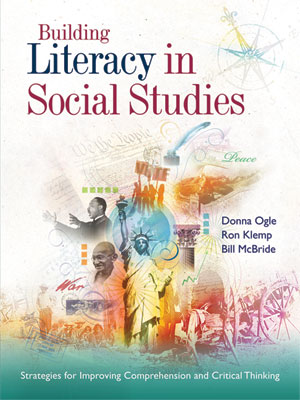
Building Literacy in Social Studies: Strategies for Improving Comprehension and Critical Thinking was written by Donna Ogle, Ron Klemp, and Bill McBride. This 218-page, 8.5" x 11" book (Stock #106010; ISBN 978-1-4166-0558-4) is available from ASCD for $23.95 (ASCD member) or $30.95 (nonmember). Copyright © 2007 by ASCD. To order a copy, call ASCD at 1-800-933-2723 (in Virginia 1-703-578-9600) and press 2 for the Service Center. Or buy the book from ASCD's Online Store.