|
Whole Child Resources
A selection of whole child resources is available below. Members may access the full text of all articles by logging in to myASCD.
|
|

|
Overview
ASCD's Position Statement on the Whole Child
Engaging the Whole Child (Summer 2007 Educational Leadership)
Educating the Whole Child (May 2007 Educational Leadership)
The Whole Child (September 2005 Educational Leadership)
ASCD Calls for a "New Compact" to Educate the Whole Child (March 2007 Education Update)
The Whole Child (Fall 2007 Infobrief)
All Together Now: Sharing Responsibility for the Whole Child ( 209 KB, July 2006)
The Whole Child in a Fractured World ( 1 MB, January 2006)
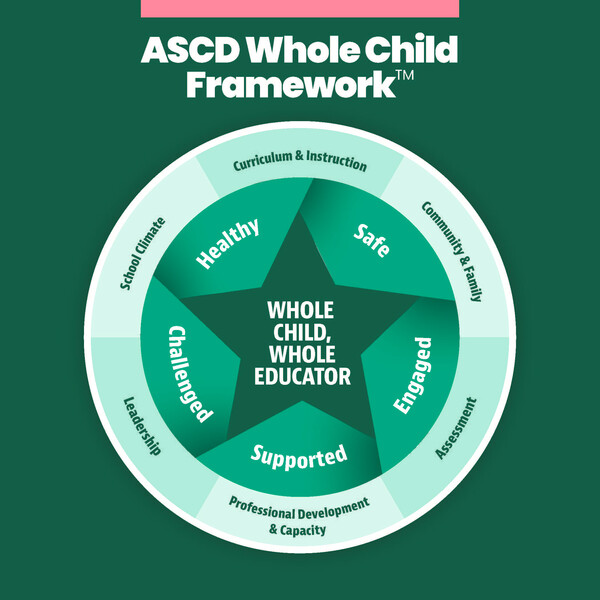
Healthy
Healthy and Ready to Learn (EL Article)
Nutrition and exercise positively affect school achievement, the former surgeon general reports. [members only]
The Achievement Gap: A Broader Picture (EL Article)
Reforming our schools is just one part of the solution: We must also address social class differences, including health status and mobility rates. [members only]
The Obesity Epidemic: What It Is Costing Schools (Audio)
Understand how poor nutrition and inactivity increase obesity and other health issues that interfere with students' school attendance and their readiness to learn. Hear about the experiences of Action for Healthy Kids and interventions to create health-promoting school environments that can bolster student achievement and ultimately improve every school's bottom line.
Creating a Healthy School Using the Healthy School Report Card: An ASCD Action Tool (Action Tool)
This tool provides a step-by-step process for engaging stakeholders in assessing how well your school meets evidence-based recommendations for ensuring a healthy, safe, and supportive environment for students and staff. The online reporting process provides documentation of those things that you are doing well and recommendations for areas that can be improved through stakeholder and community support.
Supporting Student Health and Achievement (PD Online)
While health is not the primary mission of education, educators cannot ignore the many health-related factors that interfere with effective teaching and learning. Health barriers, such as school safety, asthma, obesity, and stress, reduce students' and teachers' ability to focus on the daily tasks of education and reduce the likelihood that students will become healthy, productive adults.
^ Return to top.
Safe
The Respectful School: How Educators and Students Can Conquer Hate and Harassment (Book)
Drawing from definitive research and the experiences of young victims, this book explains fundamental changes that every school should make to preserve a respectful learning environment.
Creating Caring Schools (EL issue)
The authors in this issue suggest important ways to build the adult-student relationships that will create trust—and curtail meanness—at school.
Foiling Cyberbullies in the New Wild West (EL Article)
In the world of cyberspace, students may believe that there are no laws. That's why schools need to provide limits that keep students safe. [members only]
Managing the Angry and Aggressive Student: What to Do When Nothing Else Works (Audio)
All professionals who work with children who exhibit aggressive behaviors will benefit from listening to this energetic and research-based presentation.
How to Promote Positive Behavior Schoolwide (Video)
This video provides specific, research-based ideas that principals and other school leaders can use to promote positive student behavior in any school.
Bullying: Let's Break the Cycle (PD Online)
As long as the rate of bullying increases, we are not doing enough to create safe school environments. In this course, you will investigate the three components of an effective bullying definition, the effect of bullying on stakeholders, legal perspectives, strategies that support the bully and victim, and successful intervention programs.
^ Return to top.
Engaged
The Differentiated Classroom: Responding to the Needs of All Learners (Book)
Matching your instructional approach to the needs and interests of every student is an overwhelming challenge unless you follow the comprehensive approach offered in this book.
Motivating Students and Teachers in an Era of Standards (Book)
Learn why attending to five basic human needs is critical to school success. Explore simple strategies that make the experience of school rewarding for teachers and students.
Reaching the Reluctant Learner (EL issue)
The articles in this issue explore why some students are reluctant to participate in school and how educators can make school a more engaging experience for reluctant learners.
Students as Citizens (EL Article)
Law courses, moot courts, leadership training, and a conflict resolution program guide students to practice civic responsibility. [members only]
The Arts Make a Difference (EL Article)
Learn how arts instruction can make a difference for underachievers. [members only]
The Power of Student Voice (EL Article)
In this leadership model, students make a difference in how schools operate. [members only]
How Community Schools Make a Difference (EL Article)
Family support groups, computer classes with the community, citizenship preparation classes, and school-based health services all contribute to student learning. [members only]
Differentiating Instruction: Evidence of What's Working (Audio)
Get the latest insights on the effects of quality differentiation and the type of staff development that creates more effectively responsive classrooms. Find out what truly supports differentiated, responsive teaching.
A Visit to a Motivated Classroom (DVD)
This ASCD video takes you on an in-depth field trip to a classroom that demonstrates the research-based motivational strategies reflected in What Works in Schools.
Planned Responses to Unplanned Change (Tool Kit)
ASCD's response to 2005 hurricanes Katrina and Rita focused on providing support to the whole child through resources that addressed the physical and emotional health of students dislocated by the storms. ASCD created a series of free workshops for educators working with displaced students in Alabama, Louisiana, Mississippi, and Texas—including trained cadre and volunteer presenters—and a kit of workshop materials.
Understanding Student Motivation (PD Online)
This course will help teachers learn about the conditions that foster student motivation. Among other goals, you will learn what the data say about unmotivated students, the importance of intrinsic motivation, how to meet children's needs to enhance motivation in the classroom, and strategies to cope with challenges.
^ Return to top.
Supported
Managing Your Classroom with Heart: A Guide for Nurturing Adolescent Learners (Book)
Drawing on her own experience as a high school teacher, Katy Ridnouer shares an approach to classroom management that will help you spend less time "dealing with" your adolescent learners and more time inspiring them to be their best selves in school and beyond.
Building Classroom Relationships (EL issue)
This issue considers the many approaches to managing classrooms. The continuum ranges from punishment, control, manipulation, and rewards to respect and relationships. [members only]
Highly Qualified Teachers for All (EL Article)
Ensuring a strong teaching force is NCLB's greatest promise and should be the number-one priority. [members only]
The Magic of Mentoring (EL Article)
Local residents connect with young people in a successful mentoring program. [members only]
Succeeding in Reading with English Language Learners (Audio)
English language learners (ELLs) are one of the fastest-growing groups in U.S. schools, and they present schools with one of the largest challenges under NCLB. This audio examines and addresses issues such as language of instruction, instructional quality, support, and transitions, as well as how these issues relate to ELLs' success. The presenters focus on the issues of policy and practice that most engage educators concerned with the reading instruction of English language learners.
High Schools at Work: Creating Student-Centered Learning with Facilitator's Guide (Video)
In this video, see how innovative high schools are succeeding by being more responsive to the varied needs of their students. Use this video series in team meetings or workshops to take colleagues to rural and urban high schools that have redesigned the cultures of their schools and implemented strategies to personalize learning and help their students reach higher levels of achievement.
Helping Struggling Readers (PD Online)
This course presents strategies that teachers can use to help struggling readers. Among other course goals, participants will learn how to help students develop phonemic awareness and phonics knowledge, ways to teach vocabulary, how to help students make meaning from text, and the importance of sustained silent reading at all grade levels.
^ Return to top.
Challenged
Understanding by Design, Expanded 2nd Edition (Book)
How do you know when students understand something? Can you design learning experiences that make it much more likely that students understand content and apply it in meaningful ways?
The Prepared Graduate (EL issue)
In this issue, authors describe the skills, knowledge, and qualities that students will need to survive and thrive in the years ahead. Articles suggest strategies for preparing students to be productive workers, citizens, and family members.
Closing the Achievement Gap: A Vision for Changing Beliefs and Practices, 2nd ed. (Book)
Quickly get a study group or improvement team talking about the research and strategies for closing the achievement gap.
Integrating Differentiated Instruction and Understanding by Design: Connecting Content and Kids (Book)
Discover how two of education's most powerful frameworks can team up to provide your school with a comprehensive and in-depth approach to ensure all students are learning at maximum levels.
Self-Assessment Through Rubrics (EL Article)
By examining their own works in progress, students understand how they can improve. [members only]
When Students Choose the Challenge (EL Article)
Tasks that are at just the right level of difficulty make learning interesting. [members only]
Asking About What Matters: Essential Questions (Audio)
This audio examines how essential questions function as a bridge between engagement and understanding—an integral component of both a differentiated classroom and the Understanding by Design model. Learn what an essential question is and how it functions. This session also provides examples of intellectual incentives for students to focus on what is important.
Building Academic Background Knowledge (DVD)
This DVD helps teachers and other audiences understand what to do about students who are ill-prepared for classroom learning. Based on the best-selling ASCD book Building Background Knowledge for Academic Achievement: Research on What Works in Schools, this series of three programs on DVD introduces your school to research-based strategies for overcoming the deficiencies that hamper the achievement of so many students.
Formative Assessment Strategies for Every Classroom (Action Tool)
What are the specific skills and strategies students need to learn to assess themselves in the classroom, and how do you teach them those strategies in the context of subject-area material? This resource answers those questions and gives you more than 50 teacher and student tools to use with students in every grade level and subject.
Understanding by Design: The Six Facets of Understanding (PD Online)
This course is the second in a series designed to help practitioners understand and apply various aspects of Understanding by Design. It explores what Grant Wiggins and Jay McTighe, the framework authors, call the "six facets of understanding." These six interrelated behaviors provide avenues through which educators can observe and evaluate students' growing understanding of the curriculum they are studying.
^ Return to top.
|