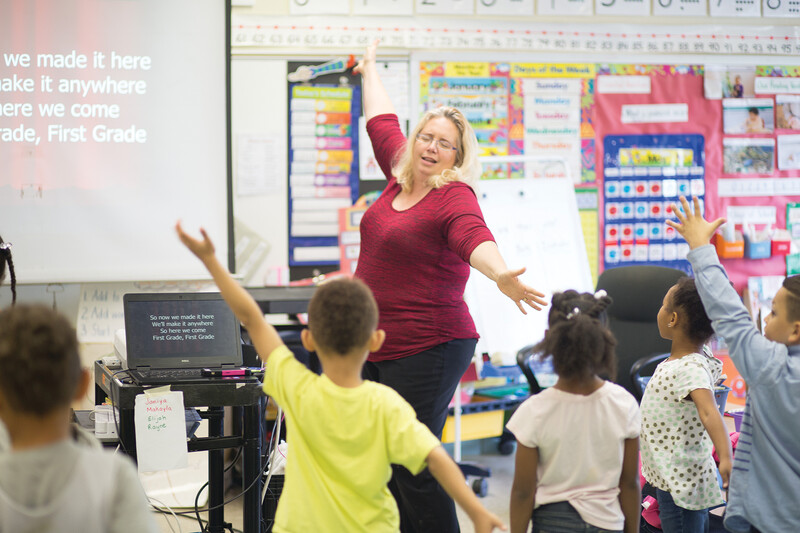
In 2009, I was named North Carolina Teacher of the Year—an honor that came with the profound responsibility of traveling the state, sharing best practices with educators, and championing what educators know to be true: that meeting every student’s individual needs should be our highest priority. I spoke passionately about differentiation, about seeing each learner as unique, about crafting instruction that would reach every child where they were. I also helped educators see that providing students with a global perspective would allow them to develop empathy and a connection to what they are learning.
Then I returned to my Spanish classroom with a renewed commitment to practice what I had been preaching.
The reality was humbling. My students arrived with vastly different backgrounds: Some had never heard Spanish, others grew up in Spanish-speaking homes but couldn’t speak it themselves, and still others were newcomers fluent in Spanish but placed in beginner classes due to administrative necessity. Each student had a different starting point, a different set of needs, and a different pathway to success.
I tried every strategy I knew. I stayed up late creating groups to address varying student needs, carefully considering learning objectives and crafting activities that would allow students to access the curriculum at their appropriate level. Despite my best efforts and intentions, I struggled to create the truly differentiated experience I knew my students deserved. The complexity of meeting so many diverse needs simultaneously felt overwhelming, and ultimately, this struggle became one of the primary reasons I left the classroom.
I often wonder: What if AI had been available when I was a classroom teacher? After serving as a district administrator for more than a decade, I now work as the senior director of Innovative Learning for ISTE+ASCD. In this role, I help educators grow in their understanding of how to use generative AI to transform the learning experience for students. This work has helped me see the potential for differentiation in a whole new light.
Even to this day, I find myself thinking about that Spanish classroom—and what might have been different. Today’s teachers face the same fundamental challenge I encountered—supporting a multitude of diverse learners in a single classroom. But now educators have access to tools that could have fundamentally changed my teaching practice.
When we combine the irreplaceable human elements of teaching—relationship-building, understanding individual contexts, and pedagogical wisdom—with AI’s capacity for rapid customization and adaptation, we create possibilities for personalized learning that neither could achieve alone.
Practical Applications: AI in Action
So how, practically, can teachers harness AI to support struggling learners in their classrooms? Here are a few ideas—each can be adapted to fit different grade levels, content areas, and student needs.
Conversation-Based Lesson Planning
Teachers can now engage AI chatbots in detailed conversations about their students’ needs without compromising privacy or violating confidentiality. By sharing general information about different learning profiles in their classrooms, educators can receive customized activity suggestions aligned to specific content standards and learning objectives.
The following steps illustrate how teachers can approach this, using an LLM that is approved by their school or district.
Step 1: Frame the context without identifying information. Instead of naming specific students, describe learning profiles: “I have a group of five students who are reading two grade levels below their peers” or “Three students in my class are English language learners with strong mathematical reasoning skills but limited academic vocabulary.”
Step 2: Specify your learning objectives and standards. Be explicit about what you want students to learn: “I’m teaching the concept of photosynthesis aligned to NGSS standard MS-LS1-6. Students need to understand the process and be able to explain how matter and energy flow through this system.”
Step 3: Request differentiated activities. Ask the AI tool to generate multiple approaches: “Can you suggest three different activities—one hands-on, one visual, and one that uses analogy—that would help students with varying reading levels access this content?”
Step 4: Apply your pedagogical framework. Direct the AI tool to align suggestions with your school’s approach: “Please design these activities using Universal Design for Learning principles” or “Ensure these activities align with Bloom’s revised taxonomy, with options ranging from remember/understand to analyze/evaluate.”
After submitting the initial prompt with these four components, begin a conversation with the AI tool to iterate and refine. Engage in follow-up questions like: “The hands-on activity is good, but it requires materials I don’t have. Can you suggest an alternative using common classroom items?” or “How could I modify the visual activity to include more opportunities for peer collaboration?”
These suggestions are starting points, not solutions. Your superpower as a teacher is knowing your students—their personalities, strengths, and specific needs.
When we combine the irreplaceable human elements of teaching with AI’s capacity for rapid customization and adaptation, we create possibilities that
neither could achieve alone.
Adaptive Content Modification
One of the most immediate applications of AI involves adjusting reading materials to meet students where they are. Teachers can input texts into AI tools and request modifications for different reading levels or even different languages. This capability is particularly powerful for supporting multilingual learners or students with varying literacy levels who need to access the same core content. Teachers must ensure they have proper copyright permissions before inputting materials, as loading certain protected content may constitute infringement—check with publishers or your district.
The technology extends beyond text simplification. AI can maintain the essential concepts and learning objectives in the text while adjusting vocabulary, sentence structure, and complexity to match individual student needs. This ensures that all students engage with grade-level content, even when the presentation is modified for accessibility.
If this technology had been available to me as a Spanish teacher, I would have provided differentiated cultural texts to maintain the same learning objectives about a cultural topic. As an example, I could have input an authentic article about Día de los Muertos and asked AI to create three versions—one using present tense and cognates for beginners, one incorporating past tense for intermediate students, and one preserving the original complexity for heritage speakers. All versions would convey the same cultural concepts and learning objectives about the holiday’s significance, but each would be accessible to students at different language acquisition stages.
Student-Facing Support Tools
Some educators have developed AI chatbots designed to provide personalized support for students during independent work time. They use tools like Gemini Gems, Playlabs’ apps, or ChatGPT’s GPTs (customizable versions of ChatGPT) to create tools that can be programmed to respond in a student’s home language and trained on specific curricular content to provide immediate, personalized support when teachers are working with other students.
For example, an AI tool might be configured to help students working through math problems by providing hints and encouragement rather than direct answers, or to support writing development by asking clarifying questions about student ideas. The key is designing these interactions to promote learning and independence rather than dependence.
As part of my role at ISTE+ASCD, I have the privilege of working with educators from across the country, like those from John Handley High School in Winchester, Virginia. Math students at John Handley have access to a tool that allows them to engage with a chatbot that will break a problem down into steps and provide examples of similar problems. A student can start with the math concepts they do understand and ask the tool to explain the next steps in the math problem based on where their current level of knowledge is. They can also ask for multiple worked-out examples so they can see the application of the steps. Once students have seen exemplars and understand the concept, they can proceed independently with more confidence. This personalized feedback complements what teachers provide, making it possible to meet individual needs even in large classes.
Live Captioning with AI
“Students who had previously struggled to talk for 3 minutes were now speaking for more than 7 minutes, and asking for more time so they could address the audience’s questions,” says Celine Perea, an instructional technology coordinator in Colorado.
In this short video, Perea shares how teachers in her district are using AI-powered live captioning to help multilingual learners find their voice. Celine Perea is part of the GenerationAI Community of Practice.
Ensuring Ethical, Human-Centered Implementation
As we integrate AI tools into our support for struggling learners, we must consider the ethical and pedagogical implications of these decisions. How do we ensure AI outputs don’t inadvertently lower expectations or create new forms of educational inequality? How do we maintain student agency and voice in learning experiences that are increasingly personalized through algorithmic processes?
The answer lies in recognizing that AI is not a silver bullet for the complex challenges of supporting struggling learners—it’s a tool that can extend human capacity when used thoughtfully. The most important aspects of teaching remain fundamentally human endeavors: building relationships, understanding individual contexts, and making professional judgments about student growth. AI tools are most effective when they amplify these human capabilities rather than attempt to replace them.
This means teachers must remain the experts in their field, using AI as a sophisticated support tool that can generate options, modify materials, and provide ideas, while maintaining responsibility for ensuring that all outputs align with what they know about their students and sound educational practice. Teachers must always critically evaluate AI outputs against effective pedagogy and individual student needs.
Your superpower as a teacher is knowing your students—their personalities, strengths, and specific needs.
But what does this look like in action? Two practices are essential:
First, give students voice in their learning. Rather than automatically assigning AI-generated modifications, talk with students about their needs and preferences. A question like, “Would you like to read this in Spanish first?” gives students ownership over their learning process.
Second, evaluate AI outputs for rigor, not just readability. When AI simplifies text or creates modified activities, check that the cognitive demand remains high. A simplified reading passage should still require students to analyze and synthesize, not just recall facts.
When implemented thoughtfully with these principles in mind, AI can help us achieve the differentiated instruction we’ve long aspired to provide, finally making good on our promise that every student’s needs will be met.
Reflect & Discuss
What barriers prevent you from differentiating instruction as effectively as you’d like? Which might AI tools help address?
How do you maintain high cognitive demand when adapting materials for struggling learners in your content area?
What policies, training, or support does your school need before teachers can use AI tools ethically with struggling learners?