

When my son was three, he experienced his first fire drill at preschool. Despite his teacher's pre-coaching, practicing what to do, and reassurance that it was a just a drill, when that bell screeched and wailed, my son came undone. The preschool called me to pick him up because, for the next few hours, he was inconsolable.
At home, we showed him how safe our own smoke detectors were—testing them so he could see everything was OK. (More tears.) He also cried on the way to school the next day. When he walked into his class, he stared with fury and fear at the alarm bell on the ceiling.
It's been a few years, and though there are no more tears when entering school or doing a drill, my son's alarm-response continues to fascinate me. The bell was a cue—albeit an unpleasant one—designed to prompt action: Move toward safety. Yet initially, the alarm did the opposite, debilitating my son as he fixated on the sound ringing in his ears, which must have felt to him as if someone or something was violating his space. He obsessed about the perceived transgression rather than seeing it as a cue for progression.
He was three, so his reaction is understandable. But how many of us adults do the same thing—obsess over the transgressions in our lives? How many unpleasant "alarms" still rattle our minds, repeating the emotional dissonance that comes with resentment? How often are we stuck plugging our ears to the noise rather than taking action?
We cannot move forward until we stop carrying the weight of the past, stop ruminating about others' transgressions (and our own mistakes). We need, more than ever, the ability to forgive—to move on from the things we cannot change.
Forgiveness as a Self-Starting Action
Forgiveness is a concept fraught with misperceptions. So, let's define it: Forgiveness means reappraising our thoughts toward a transgression or transgressor to reduce resentment and move forward (Worthington, 2005). With this definition in mind, let's look at some common myths that disrupt our ability to reap the rewards of forgiveness:
Myth #1: Forgiveness means not taking action.
Reality: As the definition suggests, the individual doing the forgiving is taking an active role. Therefore, the forgiver is exercising agency. Also, the product of forgiveness is moving forward. Adapting. Growing.
Myth #2: Forgiveness means condoning a behavior or accepting future transgressions.
Reality: We can forgive and still have boundaries. A parent can forgive their child for breaking a window and still enforce a rule of "no kicking balls in the house." A school leader can forgive a teacher for speaking rudely at a staff meeting, but still establish clear expectations of professional dialogue. And a teacher can forgive a student for plagiarizing while still holding them accountable for academic integrity. By forgiving, we choose to look to the future by taking action rather than cling to the past with anguish.
Myth #3: Forgiveness requires reconciliation.
Reality: Forgiveness is something we do for our own benefit. We can reduce the psychological anguish of a transgression without even involving the other person. We make choices on how we are going to move forward, even if the other person doesn't change.
Myth #4: We have to forgive and forget.
Reality: Many transgressions aren't forgettable—and for good reason. The greater the emotional intensity of an experience, the stronger our brain stores the memory. But our brain doesn't store these memories so we can sit and sulk; our brain increases recall so we increase response. We remember so that we learn new ways to move forward. Don't try to "forgive and forget." Instead forgive and forge ahead.

We must learn to let go of the small challenges in our lives (the pebbles) so we have the energy to address the big ones (the boulders).

Start with Pebbles, Not Boulders
When I first started teaching forgiveness, the students in my positive psychology class were resistant to it. I could get these teens to silently meditate for 20 minutes, but I couldn't get them to consider forgiveness as a critical life skill. They would write things like, "How can I forgive [transgressor] for [doing horrible thing] to me?!"
I quickly realized the hang-up: When they pictured forgiveness, they visualized forgiving the worst transgressions (or transgressors) of their lives. In reality, how many minor transgressions do we ruminate about? We stew for hours about the jerk who cut us off on the highway. At 2:00 p.m. we're still angry at the student who shouted profanity in the hallway at 9:00 a.m. We vividly relive the one insensitive comment from a colleague every time we see them—even years later.
How's that working out? Every small transgression we ruminate on takes up psychological (and physical) bandwidth that is better served elsewhere. Holding on to resentment increases our cortisol levels, our cardiovascular strain, and negative emotions (Witvliet et al., 2011). It simultaneously reduces our creative problem-solving and interpersonal skills (Lyubomirsky & Nolen-Hoeksema, 1995).
We must learn to let go of the small challenges in our lives (the pebbles) so we have the energy to address the big ones (the boulders). Here are two ways to do that:
1. The Five-Minute Resentment Reset
Next time you find yourself ruminating about something major or something minor—pause. Set a timer for three minutes and write candidly why the transgression (or transgressor) bothered you. Then, set a new timer for two minutes and write what you will do or think differently to move forward. This exercise can help us reset toward action.
2. Observe the Thought Train
One of my favorite skills of mindfulness is thought-noting—when we simply observe a thought happening in our heads without becoming attached to it. Treat your thoughts like trains that come and go through a busy station; your job is to stand on the platform and watch the trains go by (GoZen!, 2017). When you feel yourself ruminating in anger about something, prompt your thinking with this statement and questions (then habituate them):
- I notice I'm thinking about [insert resentment].
- Does this thought move me forward with positive intention? (Yes or No?)
- What thought will better help me move forward with positive intention?
Listen, Let Go, Look Forward
Alarms exist for a reason. They prepare us to act constructively when transgressions arise. But we must listen to the alarm, objectively assess what to do, and then—most important—we must act. If a preschooler can learn to listen to alarms and move forward, so can we.
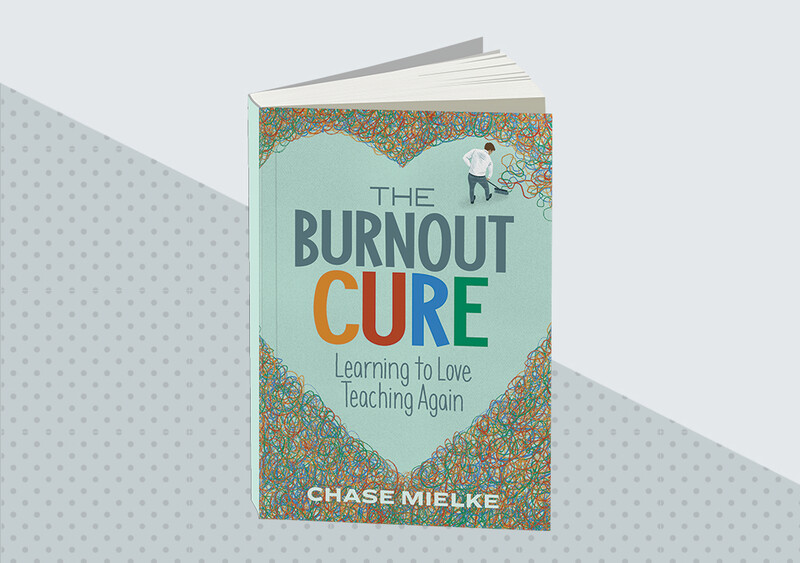
The Burnout Cure
Award-winning teacher Chase Mielke draws from his own research, lesson plans, and experiences with burnout to help educators reignite their core passion for teaching.